

By Dr. Christos Kelepouris and Chaima Kharrat
Implications
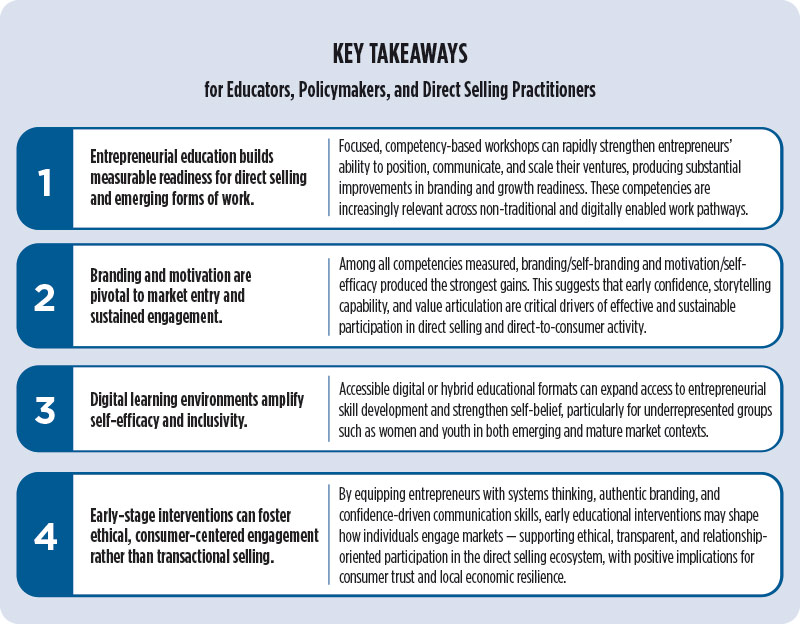
- For Educators: Integrate applied modules on branding, storytelling, systems thinking, and ethical marketing into entrepreneurship curricula to prepare learners for direct selling and related entrepreneurial pathways.
- For Industry Practitioners: Collaborate with educators to deliver targeted micro-training that builds trust-based, digitally competent, and consumer-centered sales networks.
- For Policymakers: Recognize entrepreneurial education as a lever for workforce upskilling, inclusive economic participation, and small-enterprise scalability within evolving labor market structures.
Abstract
This study examines how targeted entrepreneurial education can develop competencies foundational to ethical and effective direct selling readiness among early-stage entrepreneurs in an emerging market context. A single intensive workshop was conducted in Tunisia focusing on entrepreneurial mindset, creativity, motivation and self-efficacy, branding and self-branding, and standardization and growth readiness. A pre/post survey (n = 27) revealed statistically significant gains across all five domains, with particularly large effects for branding (d = 1.24) and standardization/growth readiness (d = 1.21). Beyond direct selling scholarship, the findings speak to broader conversations on the future of work and workforce upskilling, where non-traditional, digitally enabled entrepreneurial pathways are increasingly salient. The results suggest that entrepreneurial education can intentionally cultivate transferable competencies that support ethical, consumer-centered engagement rather than transactional selling, contributing to sustainable participation in direct selling and direct-to-consumer ecosystems.
 Introduction
Direct selling occupies a distinctive position in the global entrepreneurial landscape, offering a flexible and relationship-based pathway into commerce through personal networks and, increasingly, digital and social platforms. The model has proven particularly relevant in contexts where access to formal employment or startup capital is constrained, positioning direct selling as both an earning opportunity and an experiential learning environment for entrepreneurship (Peterson et al., 2019). Recent research highlights that microentrepreneurs now operate in hybrid environments where social commerce, e-commerce, and direct selling converge, amplifying the importance of trust, personal branding, and digital fluency (DSEF & Ipsos, 2025).
Beyond the direct selling literature, entrepreneurship education has become central to policy and scholarly discussions on the future of work and workforce upskilling. As labor markets grow more volatile and linear career pathways become less common, younger cohorts increasingly pursue flexible, self-directed, and portfolio-based forms of work. Practitioner commentary on Generation Z’s growing engagement with direct selling highlights its accessibility, digital orientation, and alignment with preferences for autonomy, purpose, and income diversification (Entrepreneur, 2025). At the policy level, discussions among U.S. lawmakers, researchers, and industry stakeholders have similarly framed direct selling as part of an evolving labor ecosystem that complements traditional employment by enabling entrepreneurial participation outside conventional organizational structures (Amway, 2024). Within this context, entrepreneurship education may serve as a critical upskilling mechanism, equipping individuals with transferable competencies, such as self-efficacy, adaptability, and consumer-centered communication, that are increasingly valuable across emerging forms of work.
While prior scholarship has examined training and performance within established direct selling organizations, limited research explores how aspiring entrepreneurs develop the psychological and practical competencies that precede formal entry into direct selling or direct-to-consumer activity. This paper addresses that gap through fieldwork conducted in Tunis, Tunisia, as part of a Fulbright Specialist assignment. Tunisia provides a compelling context for this inquiry. Like many emerging markets, it faces persistent youth unemployment and underemployment alongside growing digital connectivity, conditions that heighten the relevance of entrepreneurial and direct selling pathways. Research from other emerging economies demonstrates that direct selling can contribute to economic participation, self-efficacy, and empowerment, particularly among women, suggesting that skills cultivated prior to market entry may have broad personal and societal implications (DSEF, 2018). Situating Tunisia within this broader emerging market landscape allows the present study to generate insights relevant not only locally, but also for emerging markets more broadly and for mature economies such as the United States.
Grounded in theories of entrepreneurial self-efficacy (Bandura, 1997) and effectuation (Sarasvathy, 2001), this study investigates whether a structured entrepreneurial education intervention can enhance competencies associated with direct selling readiness. By focusing on the pre-entry stage of the microentrepreneurial lifecycle, the study extends direct selling research upstream to examine how education may shape not only readiness, but also the orientation with which entrepreneurs engage markets.
Theoretical Foundation and Literature Review
Direct selling has long functioned as a developmental system that teaches sales, leadership, and small business management through experiential learning (Coughlan & Grayson, 1998). Prior research documents that participation in direct selling itself generates a wide range of transferable skills. (Peterson et al., 2019) found that direct selling experience positively influenced fourteen business and professional skills, including communication, goal setting, self-motivation, and customer relationship management, as well as thirteen personal life skills such as confidence, resilience, and time management. More than three-fourths of respondents reported meaningful skill improvement, and self-perceived skill development was positively associated with both direct selling success and perceived performance in non-direct selling employment. Importantly, these findings suggest that the benefits of direct selling extend beyond commercial outcomes, contributing to broader personal development and societal well-being (Peterson et al., 2019).
Theories of entrepreneurial self-efficacy and effectuation help explain why such skill development is consequential. Self-efficacy theory emphasizes that individuals who believe in their capabilities are more resilient, adaptive, and persistent, traits strongly associated with entrepreneurial and selling success (Bandura, 1997). Effectuation theory similarly highlights how entrepreneurs act under uncertainty by leveraging available means, improvisation, and stakeholder relationships (Sarasvathy, 2001), processes that closely mirror direct selling practices. Recent extensions of these theories into digital learning environments demonstrate that structured educational interventions can intentionally strengthen self-efficacy, opportunity confidence, and adaptive decision-making (Rauch & Hulsink, 2021; Kelepouris, 2024).
In emerging market contexts, the developmental role of direct selling may be particularly salient. Research conducted in South Africa documents how direct selling participation supports women’s economic empowerment, social capital formation, and confidence building, especially when combined with digital tools and supportive networks (Direct Selling Education Foundation, 2018). These findings underscore that direct selling’s relevance extends beyond sales performance to broader questions of inclusion, empowerment, and sustainable economic participation, issues central to both emerging markets and evolving labor markets globally.
Methodology
The study was conducted in 2025 and involved training early-stage entrepreneurs, many selling directly to consumers in fashion, handmade goods, and digital services. The workshop covered five core themes aligned with competencies identified in the direct selling literature: entrepreneurial mindset, creativity, motivation/self-efficacy, branding/self-branding, and standardization/growth readiness.
Participants (n = 27; 60% female; ages 20–35) completed a 20-item Likert-scale assessment (1–10) before and after the workshop. The survey measured perceived competency across the five domains using items such as ‘I can clearly explain what makes my business unique’ and ‘I see problems as opportunities to create something new.’ The data was analyzed using paired-sample t-tests and Cohen’s d to assess statistical significance and effect size. Although modest in size, the sample is consistent with other field-based entrepreneurial education studies published in the Journal of Direct Selling Research, and the within-subject design provided sufficient sensitivity to detect meaningful changes across competencies.
Results
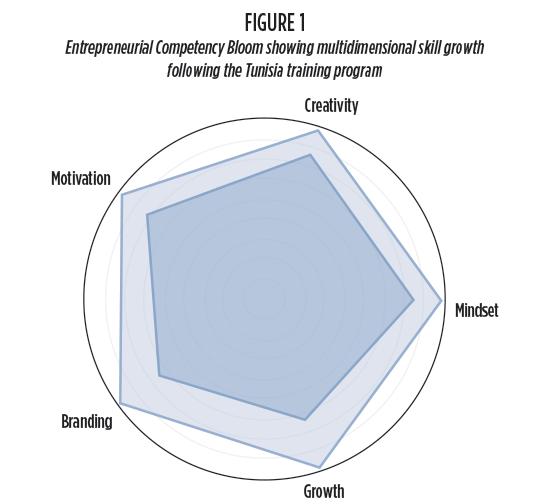
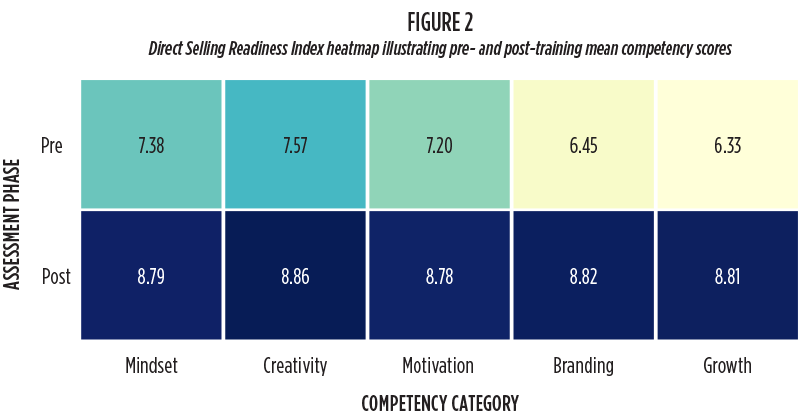
All five competency areas showed statistically significant improvement (p < .05). Mean differences ranged from +1.30 to +2.48, with the largest gains in branding/self-branding and standardization/growth readiness (Table 1). Branding & Self-Branding (d = 1.24) reflected participants’ increased ability to articulate value propositions, build trust, and use social media storytelling, key drivers of credibility in direct selling. Standardization & Growth Readiness (d = 1.21) indicated stronger understanding of systems and replication, mirroring principles of sustainable sales team development. Motivation & Self-Efficacy improved significantly (d = 0.63), aligning with Brown et al. (2025), who found that task-specific confidence predicts long-term engagement among microentrepreneurs. Moderate improvements were also observed in entrepreneurial mindset (d = 0.49) and creativity (d = 0.42).
Table 1
Pre/post-test comparison of entrepreneurial competencies showing significant improvement across all domains (p < .05)
| Competency | Pre Mean | Post Mean | Mean Diff | t | p | Cohen’s d |
| Entrepreneurial Mindset | 7.38 | 8.79 | +1.41 | 2.52 | .018 | 0.49 |
| Creativity & Innovation | 7.57 | 8.86 | +1.30 | 2.18 | .038 | 0.42 |
| Motivation & Self-Efficacy | 7.20 | 8.78 | +1.58 | 3.28 | .003 | 0.63 |
| Branding & Self-Branding | 6.45 | 8.82 | +2.37 | 6.46 | <.001 | 1.24 |
| Standardization & Growth | 6.33 | 8.81 | +2.48 | 6.28 | <.001 | 1.21 |
Discussion
Beyond measurable skill gains, the findings highlight the potential of entrepreneurial education to foster ethical, consumer-centered engagement rather than transactional selling. Improvements in branding, self-efficacy, and growth readiness suggest that participants were better equipped to articulate authentic value propositions, build trust, and engage customers through relationship-oriented practices. This orientation aligns with prior research emphasizing credibility, transparency, and trust as foundations of sustainable direct selling, particularly in digitally mediated environments where reputational signals are highly visible (Marinello, 2025).
Viewed through a future-of-work lens, the competencies strengthened in this study, self-efficacy, adaptability, personal branding, and systems thinking are increasingly transferable across non-traditional employment pathways. Policy and practitioner discourse now recognizes direct selling as one component of a broader labor ecosystem characterized by flexibility, autonomy, and multiple income streams (Entrepreneur, 2025; Amway, 2024). The Tunisian context illustrates how these dynamics play out in emerging markets, where formal employment constraints heighten the importance of entrepreneurial pathways. At the same time, the relevance of these competencies extends to mature economies such as the United States, where similar shifts toward portfolio careers and digitally enabled work are underway.
By situating Tunisia within a broader emerging market framework and linking the findings to established evidence on skill development through direct selling experience (Peterson et al., 2019), this study demonstrates how entrepreneurial education can function as an intentional form of upskilling. Rather than replacing traditional employment, such education may complement evolving labor market structures by preparing individuals to engage ethically and effectively in direct selling and related forms of work.
 Conclusion
This study provides empirical evidence that entrepreneurial education can strengthen competencies foundational to direct selling readiness while also shaping how emerging entrepreneurs engage markets. Significant gains in branding, motivation, and growth readiness suggest preparedness not only for participation in direct selling. By examining the pre-entry stage of the microentrepreneurial lifecycle, the research extends direct selling scholarship upstream and contributes to broader conversations on upskilling, emerging markets, and the future of work. For educators, policymakers, and industry practitioners, the findings underscore the value of entrepreneurial education as a mechanism for inclusive and sustainable participation in evolving economic ecosystems.
Dr. Christos Kelepouris is Co-Founder and Executive Director of AEIOU, The Academy of Entrepreneurial Innovation Opportunity and Understanding.
Chaima Kharrat is a business administration student at the International School of Business (ISB) in Sfax, Tunisia.
References
- Amway. (2024). Future of work is focus of Capitol Hill discussion featuring policymakers and researchers.Bandura, A. (1997). Self-efficacy: The Exercise of Control. W.H. Freeman.
- Coughlan, A. T., & Grayson, K. (1998). Network Marketing Organizations: Compensation Plans, Retail Network Growth, and Profitability. International Journal of Research in Marketing, 15(5), 401–426.
- DSEF & Ipsos. (2025). Consumer Attitudes Toward Direct Selling: Flexibility, Digital Connection, and Trust. Washington, DC.
- DSEF. (2018). Empowering women through direct selling in emerging markets.
- Entrepreneur. (2025). Why Gen Z is betting on direct selling and why that matters.
- Kelepouris, C. (2024). Filling the Gap: Enhancing Business Education for Tomorrow’s Business Owners. Small Business Institute Journal, 20(2), 43–46.
- Marinello, P. (2025). Strengthening trust and credibility in the direct selling channel. Journal of Direct Selling Research, 1(2), 22–27.
- Peterson, R. A., Crittenden, V. L., & Albaum, G. (2019). On the economic and social benefits of direct selling. Business Horizons, 62(3), 373–382.
- Rauch, A., & Hulsink, W. (2021). Entrepreneurial education and self-efficacy revisited. Entrepreneurship Education & Pedagogy, 4(2), 147–169.
- Sarasvathy, S. D. (2001). Causation and effectuation. Academy of Management Review, 26(2), 243–263.