

By Dr. Charla F. Brown, Dr. Victoria L. Crittenden, Dr. Joseph F. Hair, Dr. Greg W. Marshall
According to Peterson and Crittenden (2024), relatively little is known about microentrepreneurs, a subset of entrepreneurs who employ a microenterprise business model. While not easily defined given the socioeconomic heterogeneity of those engaged in microentrepreneurial endeavors (Bogenhold & Klinglmair, 2015), Barratt, Goods, and Veen (2020) expounded on this labor market trend of a network of microentrepreneurs who have shifted from dependent employees to their own boss. Zhang, Bufquin, and Lu (2019) attributed nonhierarchical relationships with a company via a platform (e.g., Uber, Airbnb, Taskrabbit) and sales of another company’s products (e.g., Amway, Mary Kay, CUTCO Cutlery) as examples of the trend toward microentrepreneurship.
The microentrepreneurial business model, however, is not a new or recent phenomenon. The peddler model of distribution that set the stage for the large independent workforce in direct selling is an early example of a pre-industrialization microentrepreneurial model (Luce & Crittenden, 2021), with Grinder, Pascal, and Schwartz (2010) noting the peddler model as one of the earliest examples of entrepreneurial marketing. Unlike small business owners, such microentrepreneurs can achieve financial and social affordances without the associated demands of becoming a small business owner. According to Torregrossa (2016), the key characteristics of microentrepreneurs are:
- They plan to keep their businesses at a manageable size, without the intention to hire employees and/or grow into a larger company.
- They can begin engaging in trade/exchange immediately without the need for infrastructures, funding, and/or a business plan.
- They often learn business skills as they go.
- They measure success in their own ways by balancing income generation with business autonomy, flexibility, long-term self-reliance, and personal well-being.
The characteristics of microentrepreneurs are exhibited in direct selling since the microentrepreneurs are backed by established brands that provide support in building the business and ongoing opportunities for development. Essentially, engaging in direct selling provides the microentrepreneur with a business-in-a-box (Crittenden & Bliton, 2019). Unfortunately, little research has been conducted that examines microentrepreneurs (Peterson & Crittenden, 2024), with traditional human and organizational research focusing attention on the more identifiable employer-employee relationship (Keith, Harms, & Tay, 2019; Meijerink & Keegan, 2019). As such, while the literature suggests that microentrepreneurs need an environment in which identities are nurtured (Barley & Kunda, 2006), there is little effort devoted to exploring human and organizational relationships that exist in the context of a labor-intensive, independent salesforce as found in the context of direct selling. Rather, Barley and Kunda (2006) noted what exists is an “excess of ideology and a dearth of data” (p. 46).
In the direct selling model of microentrepreneurship, training, socialization, and support represent resources provided by the direct selling company to offer a low-risk pathway for an individual to build his or her business. To this end, the current research was guided by the following two research questions:
- What resources encourage a direct selling microentrepreneur to persist?
- What resources can boost a direct selling microentrepreneur’s passion?
More precisely, guided by the management literature, the research examines how resources (i.e., sales training, socialization, and organizational support) and self-efficacy influence the direct selling microentrepreneur’s passion and persistence. The next section offers the theoretical framework upon which the research project was framed. In that theoretical exposition, hypotheses are derived. The research methods employed to examine the hypothesized relationships are then articulated, followed by the data analysis and a discussion of the analytical results. Implications for those engaged in the direct selling marketplace are then offered.
Theoretical Foundation
This research is grounded in two theories that provide the foundation for considerable work in the field of organizational sciences. Central to the conservation of resources theory is the resources tenet that “individuals strive to obtain, retain, foster, and protect those things they centrally value” (Hobfoll, Halbesleben, Neveu, & Westman, 2018, p. 104). Social cognitive theory provides an understanding for predicting behavior based on learning and change (Bandura, 1986). Self-efficacy is the focal construct of Social Cognitive Theory (SCT) and is defined as “belief in one’s capabilities to organize and to execute the courses of action required to produce given attainments” (Bandura, 1997, p. 2).
Conservation of Resources Theory (COR)
The conservation of resources theory (COR) is substantively a “motivational theory that explains much of human behavior based on the evolutionary need to acquire and conserve resources for survival, which is central to human behavioral genetics” (Hobfoll et al., 2018, p. 104). COR theory is one of the most researched theories in the fields of organizational sciences, being applied in studies ranging from general stress (Hobfoll, 1988) to work-specific stress (Bono, Glomb, Shen, Kim, & Koch, 2013), and burnout (Halbesleben, 2006). In COR, resources are defined as “those objects, personal characteristics, conditions, or energies that are valued by the individual or that serve as a means for attainment of these objects, personal characteristics, conditions, or energies” (Hobfoll, 1989, p. 516).
Hobfoll (1989) categorized resources into the following four resource groupings:
- Object resources – value based on a condition of their physical nature or the value assigned to them by the individual based on rarity and/or expense,
- Conditions – relative to the degree they are valued/sought after (e.g., tenure, marriage),
- Personal characteristics – based on the level of stress resistance they offer, and
- Energies – more finite (e.g., time, money, and knowledge).
At the heart of COR theory is that people are motivated to protect their resources. COR’s principle of resource investment holds that “people must invest resources in order to protect against resource loss, recover from losses, and gain resources” (Hobfoll et al., 2018, p. 105). In their work, Hobfoll et al. (2018, p. 104) maintained that people “employ key resources not only to respond to stress, but also to build a reservoir of sustaining resources for times of future need.” According to Bono et al. (2013), positive events can accumulate over time to help build resiliency in case of resource loss. From a direct selling perspective, in conjunction with COR, the variables of salesforce training, salesforce socialization, and organizational support are resources that lay the groundwork for the independent salesperson to have a stronger sense of self-worth.
Research Implications
Prioritize Sales Training and Company Connectivity
with Microentrepreneurs
- A noted strength of the direct selling industry is its established use of technology to foster relationships, enhance product knowledge, and lend company-provided content to support marketing efforts.
- Direct selling companies can continue to monitor which resources best fit the needs of the sales organization.
Prioritize Intentional Passion-Building
- Task-specific self-efficacy can be associated as a person’s belief in his or her abilities rather than an individual’s self-esteem or intentions. As such, it can be a predictor of accomplishment depending on whether a person believes he or she can complete the task, and it can be a critical component to summoning the motivation to continue.
- In this study of direct sellers, microentrepreneurial passion is a tool through which self-efficacy increases the likelihood a direct seller will persist. Operating as a mediator, passion served as a link between task-specific self-efficacy and microentrepreneurial persistence.
- Direct selling companies should continue to prioritize intentional passion-building within their salesforce.
Passion and Persistence Spur Sales Success,
Build Reservoirs of Resources for Challenging Times
- The results of this research suggest that microentrepreneurial passion and persistence make a powerful combination that can spur sales success. The results provide support for the mediating role of passion through task-specific self-efficacy to microentrepreneurial persistence.
- As direct selling microentrepreneurs build reservoirs of sustaining resources for times of future need, they equip themselves to handle future challenges in the marketplace.
Social Cognitive Theory (SCT)
From the SCT perspective, Bandura (1982) proposed four primary ways to increase self-efficacy:
- Enactive mastery (gaining expertise through task-specific or work-related experience),
- Vicarious modeling (learning through observation or comparison of others),
- Verbal persuasion (gaining encouragement from verbal affirmation and/or perceived support), and
- Emotional arousal (using psychological and emotional states to boost confidence).
- Enactive mastery captures the experience of task performance. Bandura (1982) declared it the most influential and authentic source of efficacy information. Experience can make a lasting impression. Success can beget success; just as failure can beget failure. Successful experiences can heighten perceived self-efficacy; just as repeated failures can decrease it. As knowledge and skill development increase, task mastery can increase.
Bandura (1982, p. 126-127) defined vicarious modeling as “Seeing similar others perform successfully can raise efficacy expectations in observers who then judge that they too possess the capabilities to master comparable activities.” Learning by such observation “enables people to acquire rules for generating and regulating behavioral patterns without having to form them gradually by tedious trial and error” (Bandura, 1982, p. 19). A competent role model can both share knowledge and information in context of the environment and communicate appropriate strategies to overcome challenging situations.
Verbal persuasion can encourage an individual’s capability beliefs regarding task and/or goal achievement. The influence of verbal affirmation, social persuasion and encouragement can generate enduring increases in self-efficacy beliefs (Anderson & Betz, 2001; Bandura, 1982). Accordingly, Bandura (1982) claimed the persuasive boosts in self-efficacy can direct them to try hard enough to succeed, thereby promote skill development and a sense of personal efficacy. Persuasive efficacy’s impact can be greatest when the encouragement is realistically grounded and is considered reasonable by the individual based on past performance or similar circumstance. What a person believes about their ability can affect what he or she can achieve.
Emotional arousal incorporates an individual relying on their “physical and emotional states in judging their self-efficacy” and can be strengthened in relation to a reduction in stress or anxiety (Bandura, 2012, p. 13). By using psychological and emotional states to boost confidence, an individual can judge their capabilities in relation to the situation and expectation of success.
Self-efficacy research is divided into two categories: general self-efficacy and task-specific self-efficacy. In his meta-analysis regarding self-efficacy and personal selling, Peterson (2020) described general self-efficacy as an overall confidence one has in his or her capabilities, and task-specific self-efficacy as a belief in ability subject to specific tasks or circumstances. He asserted that general self-efficacy is more commonly identified as a fixed personality trait, whereas task-specific self-efficacy can be modified, developed, and changed over time. The sales literature supports the use of task-specific self-efficacy in relation to sales-related outcomes (Brown, Cron & Slocumb 1998; Chowdhury 1993; Sujan, Weitz & Kumar, 1994).
Microentrepreneurial Passion and Persistence
Passion research is central to the entrepreneurial literature. Baum and Locke (2004) were proponents of passion as a means of enabling entrepreneurs to face challenges of uncertainty, resource shortages, surprises, and rapid change. Cardon, Wincent, Singh, and Drnovsek (2009, p. 517) later defined entrepreneurial passion as, “consciously accessible, intense positive feelings experienced by engagement in entrepreneurial activities associated with roles that are meaningful and salient to the self-identity of the entrepreneur.”
Entrepreneurial persistence is the sustained use of goal-directed energy over time (Cardon & Kirk, 2015; Shane, Locke, & Collins, 2003). It requires motivation, confidence, and resilience (Baum, Frese, & Baron, 2014; Shane et al., 2003). The literature utilizes several terms interchangeably when discussing persistence – grit, tenacity, perseverance, and goal-direction (Baum & Locke, 2004; Duckworth, Peterson, Matthews, & Kelly, 2007; Howard & Crayne, 2019; Shane, Locke, & Collins, 2003).
However, even with a toolbox of resources and tapping into emotional sustenance, fulfilling what a direct seller aims to accomplish is not without difficulty. Persistence through difficulty, fueled by passion, might be the difference between accomplishment and defeat. Dale Carnegie spoke to the need for both passion and persistence when he said, “Flaming enthusiasm, backed up by horse sense and persistence, is that quality that most frequently makes for success.”
Conceptual Model
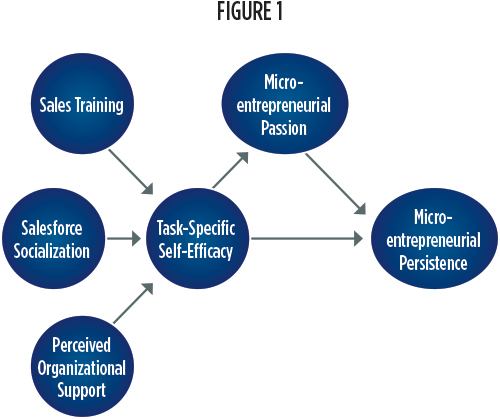
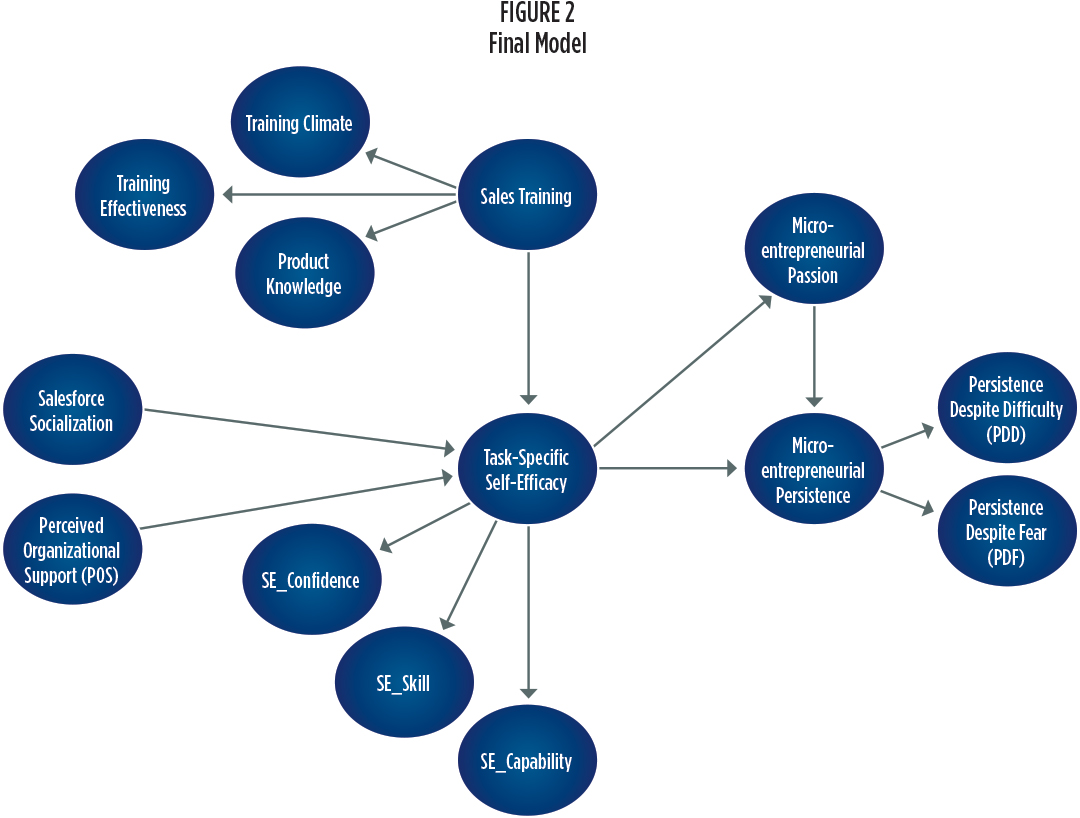
With COR and SCT as complementary, adjoining theories, the hypothesized model in the current research is shown in Figure 1. The three independent variables explored in this study are: sales training, salesforce socialization, and perceived organizational support. Foundationally, SCT explains human functioning through a trio of factors (behavioral, personal, environmental) that can influence a person’s learning experience and capabilities. By operationalizing Bandura’s (1982) four sources of self-efficacy, these three independent variables are argued to serve as predictive vehicles to influence a salesperson’s task-specific self-efficacy while also mirroring the behavioral, personal, and environmental factors identified in SCT. Drawing from principles of COR and SCT, the study reported here investigated the influence of sales training, salesforce socialization, and perceived organizational support on task-specific self-efficacy, and, ultimately, on microentrepreneurial passion and persistence.
Hypotheses Development
Sales Training
Wilson, Strutton, and Farris (2002, p. 78) defined sales training as a “deliberate and formalized accumulation of information, concepts, and skills that are intended to foster competence or enhance the performance of salespeople.” As the direct seller’s sales role expands, so do increasing requirements to “process, internalize, and manage requisite capacities to fulfil their job roles” (Sager, Dubinsky, Wilson, & Shao, 2014, p. 1). Sales training is a program and a process; it is a conduit of information and an organizational channel for communication. Sales training is an investment. As Cummings (2004, p. 26) argued, organizations that “skimp on training, particularly for new sellers, risk losing staff—and sales.”
Numerous scholars (e.g., Attia, Honeycutt, & Leach, 2005; Bradford, Rutherford, & Friend, 2017; Lassk, Ingram, Kraus, & Mascio, 2012; Pelham & Kravitz, 2008; Román, Ruiz, & Munuera, 2002) have conducted research in sales training and its impact. In their meta-analysis, Singh, Manrai, and Manrai (2015) reviewed 56 articles of sales training research spanning from 1985 to 2014. They advocated enhanced sales training skills to be a potential source of a firm’s competitive advantage. The authors pointed to advanced technology, customer relationship management, and globalization as sources of the potential importance of sales training programs, and they asserted the potentiality of productivity and financial gains as reason to view sales training as a firm resource.
Thus, the following hypothesis is offered:
H1: Sales training is positively associated with task-specific self-efficacy.
Salesforce Socialization
As the foundational study regarding socialization in a sales context, Dubinsky, Howell, Ingram, and Bellenger (1986) asserted that successful assimilation of the salesforce was critical to an organization’s overall sales success. Salesforce socialization is a process through which an individual comes to understand behaviors, gains social knowledge, and develops skills associated within an organization’s sales role. This socialization can take place via training, observation, and experience. Sager et al. (2014) claimed that salesforce socialization’s critically important capacity to link goals and behaviors, increase sales job proficiencies, and build beliefs regarding those proficiencies is often downplayed or outright ignored.
As the social aspects of salesforce socialization are expected to increase task-specific self-efficacy through vicarious modeling and verbal persuasion and encouragement via organizational assimilation in microentrepreneurs, the following hypothesis is offered:
H2: Salesforce socialization is positively associated with task-specific self-efficacy.
Perceived Organizational Support
Perceived organizational support refers to the beliefs employees form regarding the “extent to which their organization values their contributions and cares about their wellbeing” (Eisenberger, Huntington, Hutchison, & Sowa, 1986, p. 500). As employees tend to assign humanlike characteristics to their organization, perceived organizational support is filtered through their perceptions of favorable or unfavorable treatment. According to this logic, favorable treatment by the organization equates to an organization’s favor regarding the employee. Conversely, an organization’s unfavorable treatment of the employee signals its disfavor. Further, the humanistic characterization of the organization affects how employees attribute an organization’s intent. Just as in social relationships, there are similarities in the formation of POS regarding an organization’s intent and/or commitment to the employee. Eisenberger et al. (1986) ascribed attributional heuristics on employees’ perception of resources received from the organization as either sincerely/voluntarily given and earned versus resources given through legal parameters or regulatory enforcement. Perceived organizational support is looked upon more favorably if the recipient believes they result from the organization’s voluntary actions as opposed to external constraints (Rhoades & Eisenberger, 2002).
In a meta-analysis designed to evaluate organizational support theory, Kurtessis, Eisenberger, Ford, Buffardi, Stewart, and Adis (2017) reviewed 558 organizational support theory studies based on hypotheses involving social exchange, attribution, and self-enhancement. Generally, the results indicated that perceived organizational support is inherently important in the employee-organization relationship, with positive implications regarding an employee’s well-being and favorable view of the organization. DeConinck and Johnson (2009) examined the effects of perceived organizational support as it related to salesforce turnover in 384 salespeople. The authors found that perceived organizational support positively related to organizational commitment.
As perceived organizational support can encourage salesperson well-being through emotional arousal via reducing work-related stress, providing positive coping strategies for the work environment, and promoting self-enhancement by fulfilling socioemotional needs in microentrepreneurs, the following hypothesis is offered:
H3: Perceived organizational support is positively associated with task-specific self-efficacy.
Microentrepreneurial Persistence
Ahearne, Mathieu, and Rapp (2005) found that a salesperson’s persistence and engagement may increase as self-efficacy increases. Thus, the higher the self-efficacy, the higher the likelihood that a salesperson will be persistent and engage in task-specific sales activities. That is, salespeople are more likely to persist in activities in which they have confidence. With each challenging encounter, salespeople with high self-efficacy develop confidence and a sense of greater competence. Higher levels of confidence can foster a cycle of increased effort and participation as competence increases. Greater levels of self-efficacy can impact an employee’s behavior through an increase in the areas of effort allocation, persistence, and coping strategies when faced with task-related obstacles (Chebat & Kollias, 2000; Srivastava & Sager, 1999). Brown et al. (1998) found that salespeople with higher self-efficacy set higher goals and were more likely to achieve them.
Research has shown self-efficacious individuals tend to take advantage of built-in organizational opportunities. Self-efficacious salespeople manage resources from their organization in anticipatory response to work demands and challenges, finding that higher levels of self-efficacy led to greater focus, competence, and confidence in these individuals performing their work (Mulki, Lassk & Jaramillio, 2008). This is consistent with COR in that salespeople are motivated to build resource reservoirs to equip themselves to handle future challenges. Thus,
H4: Task-specific self-efficacy is positively associated with microentrepreneurial persistence.
Microentrepreneurial Passion
Vallerand, Blanchard, Mageau, Koestner, Ratelle, Léonard, Gagné, and Marsolais (2003, p. 756) defined passion as “a strong inclination toward an activity that people like, that they find important, and in which they invest time and energy.” Forest, Mageau, Sarrazin, and Morin (2011) asserted that passionate activities are more central to the individual’s identity and can, therefore, be expected to have greater personal, positive impact than goals or motivation. Cardon and Kirk (2015, p. 1041) examined the emotions of passion and persistence together, “If we don’t consider passion or other emotions in our research on persistence, then we may be missing a full understanding of drivers of this and other important outcomes in entrepreneurship.”
COR theory discusses a building up of resources as laying the groundwork for positive gain spirals to occur. Recognizing that positive gain spirals can take time to build (Hobfoll et al., 2018) the positive gains inherent in building task-specific self-efficacy may also take time to build. As the positive gains in task-specific self-efficacy serve as resources that can have an impact on microentrepreneurial passion through replenishment via their resource investment, the following hypothesis is offered,
H5: Task-specific self-efficacy is positively associated with microentrepreneurial passion.
As microentrepreneurial passion reflects the consciously accessible, intense positive feelings experienced by engagement in microentrepreneurial activities, the following hypotheses are examined in the research:
H6: Microentrepreneurial passion is positively associated with microentrepreneurial persistence.
H7: Microentrepreneurial passion mediates the relationship between task-specific self-efficacy and microentrepreneurial persistence.
The following section describes how the trio of independent variables was examined as key resources to help promote further resource gain and how these resources contribute to giving direct selling microentrepreneurs the passion to persist with their business-in-a-box.
Research Methodology
The research methodology employed in this project utilized knowledge gained from previous direct selling research conducted by Peterson, Crittenden, and Albaum (2019) and Crittenden, Crittenden, and Ajjan (2019) in which data from direct sellers were derived as clearly and precisely as possible. To this end, a questionnaire was developed that would capture, rigorously and theoretically, the information about the hypothesized relationships and a data collection process was identified. In this section, both the questionnaire design and the data collection process are articulated. Additionally, a demographic overview of the respondents is also provided here.
Questionnaire Design
A survey instrument was developed from items adapted from previously validated scales. In general, the scales were developed originally for companies and/or sales divisions within companies. Thus, minor editing was completed to adapt all scales to a direct selling context. In addition, a limited number of items were added, where appropriate, to update the measures for emerging social media and business analytics topics. Demographic information was also collected.
Sales training was measured using items adapted from four sales training scales and was assessed through the dimensions of perceived sales training climate, perceived sales training effectiveness, and product knowledge. Perceptions of sales training were measurement utilizing Sager et al.’s (2014) three-item training climate scale and four-item organizational support of training scale. Direct sellers’ perceptions of the overall effectiveness of their company’s sales training were measured by Johlke, Stamper, and Shoemaker’s (2002) perceptions of firm training scale. Perceptions of the effectiveness of their company’s product knowledge sales training was assessed using the Wilson et al. (2002). Additionally, three items were added from Rentz, Shepherd, Tashchian, Dabholkar, and Ladd’s (2002) technical knowledge scale. All items were on a 7-point Likert-type scale ranging from 1 (strongly disagree) to 7 (strongly agree).
Salesforce socialization was assessed using the social aspects (i.e., serial and investiture socialization dimensions) from Jones (1986). In addition, several new items were added to extend the queries about socialization in terms of perceived value to the company. Respondents answered on a 7-point Likert-type scale ranging from 1 (strongly disagree) to 7 (strongly agree).
Direct sellers’ perceptions of organizational support were assessed using eight items adapted from Evans, Landry, Li, and Zou’s (2007) sales supportiveness scale. Evans et al. adapted their measure to a sales context from Wayne, Shore, and Liden’s (1997) short-form adaptation of Eisenberger et al.’s (1986) Survey of Organizational Support. A 7-point Likert-type scale ranging from 1 (strongly disagree) to 7 (strongly agree) was used.
Task-specific self-efficacy was measured using items adapted from three self-efficacy scales. Direct sellers’ confidence for selling compared to others was measured using seven items adapted from Jones’ (1986) eight-item self-efficacy scale. Intuitive selling skills assessment was adapted from Sujan et al.’s (1994) seven-item self-efficacy as a salesperson scale. Skills capability assessment was measured using Wang and Netemeyer’s (2002) self-efficacy scale, capturing the confidence level a salesperson has in their capability to do their sales job. A 7-point Likert-type scale ranging from 1 (strongly disagree) to 7 (strongly agree) was used for all items.
Microentrepreneurial passion was measured using 10 items adapted from Cardon, Gregoire, Stevens, and Patel’s (2013) entrepreneurial passion scale. The original scale included 13 items assessing two dimensions (intense positive feelings and identify centrality) across the domains of inventing, founding, and developing. Items were adapted from the domains of inventing, founding, and developing into an overall domain of direct selling. Four items were retained from the original 13-item scale with no adjustments and six items were modified to reflect a direct selling context. Direct sellers responded on a 7-point Likert-type scale ranging from 1 (strongly disagree) to 7 (strongly agree).
Microentrepreneurial persistence was assessed using an adapted version of Howard and Crayne’s (2019) Multidimensional Persistence Scale (MPS). The MPS is a 13-item measure that assesses three dimensions of persistence: Persistence Despite Difficulty (five items), Persistence Despite Fear (five items), and Inappropriate Persistence (three items). Only the Persistence Despite Difficulty and Persistence Despite Fear dimensions were used and adapted to a direct selling context. Responses were on a 7-point Likert-type scale ranging from 1 (strongly disagree) to 7 (strongly agree).
Additionally, to gain a better understanding of how direct selling microentrepreneurs receive training (e.g., in-person versus online) and the hours associated with each type, the following questions were asked: “How many hours of face-to-face (in-person) sales training have you received in the past year?” and “How many hours of online (not in-person) sales training have you received in the past year?” In assessing how often direct sellers engage in digital sales training activities, survey respondents were asked to indicate their frequency of use on a graphical slider bar scale, with 0=Never to 10=Very Frequently/Daily. Digital training tools queried were instructor-led sales training videos, interactive online sales coaching, downloadable sales training kits, and self-selected online sales training courses. Finally, in gauging how often direct sellers utilize digital support tools, survey participants were asked to indicate their frequency of use on a graphical slider bar scale with 0=Never to 10=Very Frequently/Daily. The following digital support tools were included: communicating within direct selling company (e.g., instant messaging, text messaging, blogs, dashboards); interacting within company via private social media platforms; participating in web-based video conferencing (e.g., Zoom, Microsoft Teams, Skype); utilizing downloadable social media content via a mobile device.
As typical in survey work and in particular in previous studies of direct sellers, demographic information was collected regarding education level, gender, race, ethnicity direct selling industry tenure, direct selling hours worked per week, direct selling product category, and direct sales average monthly income.
Data Collection
A sample of direct sellers was obtained by means of an Internet-based survey via the use of Qualtrics. The survey employed standard screening protocols to obtain meaningful data. Initially, the survey included a screening verification question confirming the participant was 18 years of age or older, proficient in the English language, currently engaged as a direct seller, and willing to participate in the study. Participants who did not answer affirmatively were not allowed to continue with the survey.
Following the initial screening question, a rigorous screening protocol was employed to ensure all respondents were involved in direct selling. After clearing the initial, standard protocol screening, the participant was provided an expanded description of the terms “direct selling” and “direct seller.” The expanded description of direct selling and direct seller terms was:
“In this questionnaire, you will see the term ‘direct selling.’ For the purposes of this questionnaire, we consider direct selling to be a business model that provides entrepreneurial opportunities to individuals as independent contractors to market and/or sell products and services, typically outside of a fixed retail establishment. Direct selling includes sales made through one-to-one selling, in-home product demonstrations, as well as online sales. Compensation is based on sales and may be earned based on personal sales and/or the sales of others on their sales team. A ‘direct seller’ is an individual affiliated as an independent contractor with a direct selling company, who 1) sells products/services to consumers, and 2) may sponsor people to join their direct sales team.”
Directly after this description, participants were asked, “Are you currently an independent contractor (i.e., an independent associate) for a direct selling company?” Participants who did not answer affirmatively were not continued with the survey effort. To further screen appropriate direct selling participants, potential respondents were then asked, “How many direct selling companies are you affiliated with?” Possible responses were “I am not affiliated with a direct selling company,” “one direct selling company,” “two direct selling companies,” and “more than two direct selling companies.” Again, participants who answered they were not affiliated with a direct selling company were removed from the survey. Individuals who declared affiliation with one or more direct selling companies were also asked to provide the company’s name. This additional screener served as a manual check to ensure an appropriate sample.
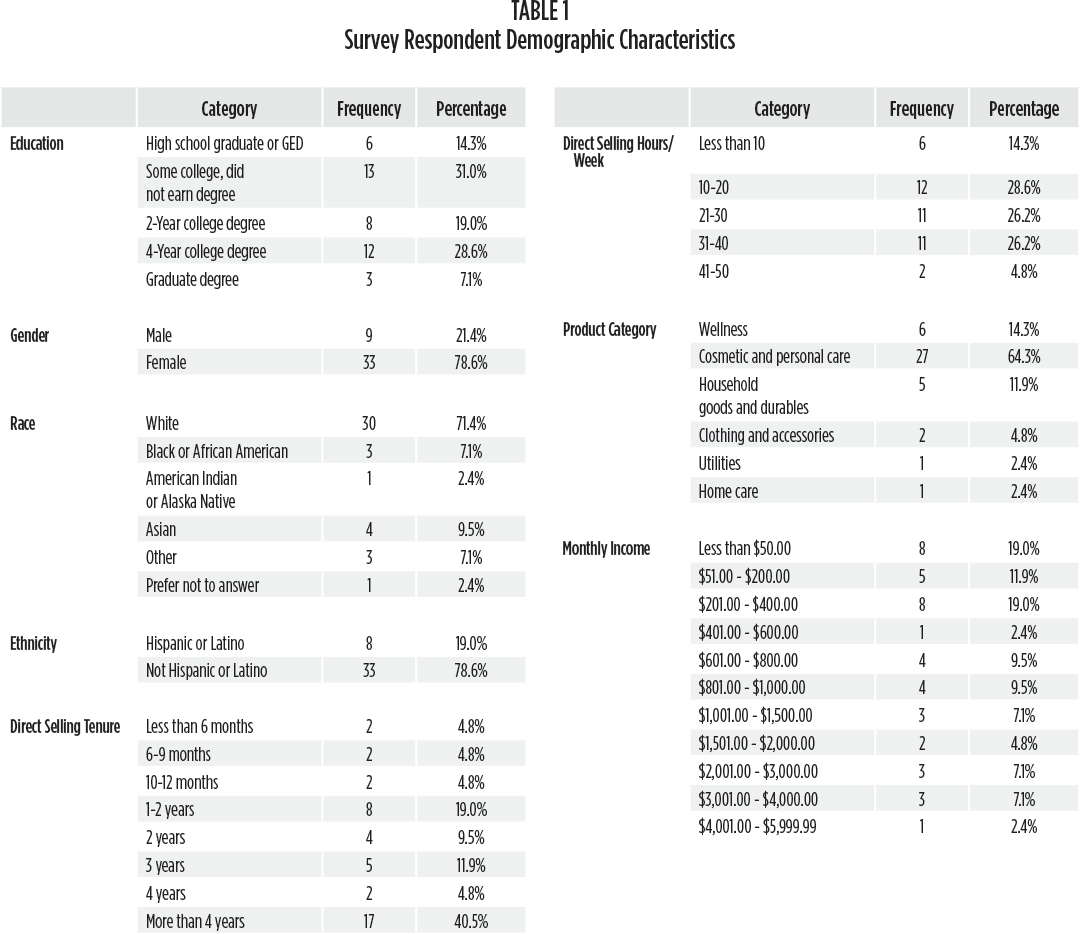
Rigorous participant screening and continual refinement of the Qualtrics sales panel inclusion criterion yielded responses from 42 verified microentrepreneurs engaged in direct selling activities. The demographic characteristics of the sampled group are displayed in Table 1.
Data Analysis
Partial least squares structural equation modeling (PLS-SEM) was selected for this data for several reasons. One, the research objective involved prediction of theoretical relationships in assessing the role of organizational resources and task-specific self-efficacy in influencing microentrepreneurial passion and persistence. Two, PLS-SEM enables the ability to work with non-normal data with sample size challenges. Three, the technique offers the flexibility in assessing higher-order constructs. Specifically, PLS-SEM derives solutions with small sample sizes when models are comprised of many constructs and a large number of items (Hair, Ringle, & Sarstedt, 2011; Hair, Risher, Sarstedt, & Ringle, 2019).
The evaluation of a PLS-SEM model includes a two-stage assessment of first the measurement model, followed by a subsequent evaluation of the structural model (Sarstedt, Hair, Cheah, Becker, & Ringle, 2019). The data were analyzed using the Confirmatory Composite Analysis (CCA) process for partial least squares structural equation modeling (Hair, Howard, & Nitzl, 2020). Smart PLS-SEM 3.0 was used to execute PLS-SEM and assess the measurement and structural models.
The final model, including construct indicators, is shown in Figure 2. To test the hypotheses, the model was assessed for significance and relevance of the path coefficients. Confirmatory composite analysis (CCA) is the recommended approach for assessing PLS-SEM results (Hair et al., 2020). In using CCA, the following analyses were examined: estimates of loadings and significance, indicator and composite reliability, average variance extracted, discriminant validity, and selected prediction metrics, including PLSpredict (Schmueli, et al., 2019). To test the hypotheses, the model was then assessed for the significance and relevance of the path coefficients. Table 2 provides the path coefficients and significance for the hypothesized relations and for training, task specific self-efficacy, and microentrepreneurial persistence as higher order constructs.
In the next section, the results of this data analysis are presented for each hypothesis and for the additional training characteristics for which the respondents were queried that addressed the questions underpinning this research effort:
- What resources encourage a direct selling microentrepreneur to persist?
- What resources can boost a direct selling microentrepreneur’s passion?
Results
The seven research hypotheses related to how resources contribute to giving direct selling microentrepreneurs the passion to persist with their business-in-a-box are restated here:
H1: Sales training is positively associated with task-specific self-efficacy.
H2: Salesforce socialization is positively associated with task-specific self-efficacy.
H3: Perceived organizational support is positively associated with task-specific self-efficacy.
H4: Task-specific self-efficacy is positively associated with microentrepreneurial persistence.
H5: Task-specific self-efficacy is positively associated with microentrepreneurial passion.
H6: Microentrepreneurial passion is positively associated with microentrepreneurial persistence.
H7: Microentrepreneurial passion mediates the relationship between task-specific self-efficacy and microentrepreneurial persistence.
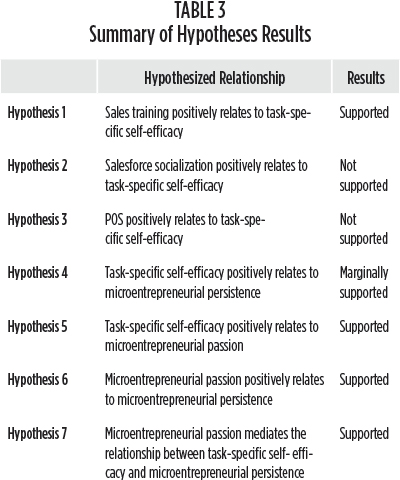
H1-H3 proposed positive associations between the variables of sales training, salesforce socialization, and perceived organizational support with task-specific self-efficacy. H4 & H5 proposed positive associations with microentrepreneurial persistence and microentrepreneurial passion, respectively. H6 proposed a positive association with microentrepreneurial passion with microentrepreneurial persistence. The summary results of the hypotheses testing are offered in Table 3. The results indicated full support for H1, H5, H6, and H7, marginal support for H4, and no support for H2 and H3.
Of the trio of independent resource variables predicted to help promote further resource gain and contribute to giving direct selling microentrepreneurs the passion to persist with their business-in-a-box, sales training (H1) was the resource most strongly predictive of task-specific self-efficacy. It might be that the small sample size contributed to the lack of support for salesforce socialization and perceived organizational support and is something that deserves further investigation. In terms of sales training, the current data suggest that successful experiences through sales training can heighten task-specific self-efficacy. Through a multi-faceted training experience, a direct seller can be exposed to potential selling situations in a learning environment, observe and emulate others, and receive verbal encouragement lending confidence in selling skills and increasing self-efficacy beliefs.
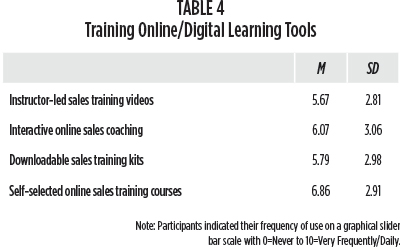
Sales training programs represent actionable, practical resources that can help propel sales success. In addition to the scale items capturing dimensions of sales training, questions regarding frequency of use of a direct selling company’s digital learning and support tools were included in the survey. Online and/or digital learning tools include use of instructor-led sales training videos, online sales coaching, downloadable training kits, and self-selected online training courses. These tools offer flexibility in online delivery and can be customized to the training needs of a direct seller.
Table 4 shows the means and standard deviations of the responses. Interestingly, there was dispersion in reported frequency of use, with evenly distributed responses on both ends of the scale. This finding can lead to actionable results for the direct selling company. Gaining a greater understanding of which tools are most frequently used can help tailor a company’s digital offering to fit specific salesforce needs.
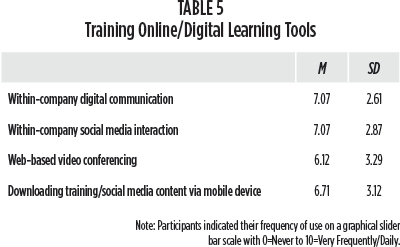
In similar fashion, survey participants were asked to assess frequency of use of their company’s online and digital training support tools. These support tools included assessing within-company digital communication (e.g., instant messaging, text messaging, blogs, dashboards), within-company social media interaction, participating in web-based video conferencing (e.g., Zoom, Microsoft Teams, Skype), and downloading training/social media content via a mobile device.
The results shown in Table 5 indicate more frequent use of digital support, especially in the areas within-company digital communication and downloading training/social media content. Direct sellers commonly use this path of digital connectedness to foster relationships, enhance product knowledge, and company-provided content to support marketing efforts (Fleming, 2019). These digital support tools can offer a direct selling company connection and training consistency with a remote salesforce.
Once built, via the impact of sales training, task-specific self-efficacy was hypothesized to increase both microentrepreneurial persistence (H4) and microentrepreneurial passion (H5). Of the hypothesized associations, self-efficacy influenced both passion (p<.001) and persistence (p<.02) positively. This pathway of self-efficacy to passion to persistence indicates those who are higher in task-specific self-efficacy are more likely to experience passion for their direct selling activities, thus making them more inclined to persist (Bandura 1982, 1997; Brown et. al., 1998; Cardon & Kirk, 2015; Holland & Shepherd, 2013). As such, a direct selling microentrepreneur’s task-specific self-efficacy perceptions, coupled with persistence in goal-pursuit, represent a potentially important link in influencing direct selling success. However, the relationship between task-specific self-efficacy and persistence in this sample was weak (p < .10).
The discovery illustrates the importance of passion in the self-efficacy to persistence path and strengthens the assertion that passion helps drive the relationship between the two. Cardon and Kirk (2015) reached similar findings using a different conceptualization of entrepreneurial passion (i.e., passion for inventing, passion for founding, and passion for developing). Following a hierarchical regression framework, their results indicated a significant relationship between entrepreneurial self-efficacy and entrepreneurial persistence before passion was entered into the model. Once dimensions of passion were entered, the significance of entrepreneurial self-efficacy either decreased or became non-significant. Positive gains in task-specific self-efficacy serve as resources that can have an impact on microentrepreneurial passion. It could be that passion is increased through resources gained, particularly through sales training and self-efficacy.
Finally, passion was also expected to amplify persistence (H6). Passion and persistence are considered drivers of entrepreneurial action. Cardon and Kirk (2015, p. 1041) examined the critical role of entrepreneurial passion in overcoming the challenges inherent to starting and running a business and stated, “If we don’t consider passion or other emotions in our research on persistence, then we may be missing a full understanding of drivers of this and other important outcomes in entrepreneurship.” In the current research, direct selling microentrepreneurial passion strongly influenced microentrepreneurial persistence. As microentrepreneurial passion reflects the consciously accessible, intense positive feelings experienced by engagement in microentrepreneurial activities, passion serves as the driver of sustained action through persistence. The current study demonstrates such passion-related intentions and behaviors can amplify a direct selling microentrepreneur’s ability to persist.
The final hypothesis (H7) stated that microentrepreneurial passion mediates the relationship between task specific self-efficacy and microentrepreneurial persistence.
As the relationship was marginally significant between task-specific self-efficacy and microentrepreneurial persistence, the hypothesized model was rerun in the absence of passion. Results revealed a strong direct relationship between task-specific self-efficacy and persistence, with a path coefficient suggesting that passion partially mediates the relationship between task-specific self-efficacy and microentrepreneurial persistence. The total indirect effect from task-specific self-efficacy to microentrepreneurial persistence through microentrepreneurial passion was statistically significant and meaningful. These results indicate further support for the mediating role of passion through task-specific self-efficacy to microentrepreneurial persistence.
Implications for Practice
Sales training emerged as an applicable resource in this model of direct selling microentrepreneurial passion and persistence through its influence on task-specific self-efficacy. Sales training is an investment, a program, and a process. As such, sales training can serve as a directive conduit of information as well as a channel of communication with a remote salesforce. Because of its potential to improve company connectivity with microentrepreneurs, sales training can be characterized, beyond salesforce socialization and perceived organizational support, as a crucial direct selling company resource. Direct selling companies should continue prioritizing effort in bolstering their training programs.
Sales training tools can be dispersed virtually and can lessen the distance between a direct seller and the company. Just as respondents in the current research were asked to rate the frequency of use of specific sales training tools and digital support, a direct selling company can employ similar within-company measures. Direct selling companies gain practical insight on company-specific sales training resources routinely used by their salesforce through continually monitoring these training tools and resources. Instructor-led sales training videos, online sales coaching, downloadable training kits, and self-selected online training courses offer flexibility in online delivery and can be customized to the training needs of a direct seller.
A noted strength of the direct selling industry is its established use of technology to foster relationships, enhance product knowledge, and lend company-provided content to support marketing efforts. Technology allows for an actionable approach to bolstering such communication. As digital training and communication efforts offer increased connectivity and consistency with a remote salesforce, direct selling companies can continue to monitor which resources best fit the needs of the sales organization.
In the context of professional selling, perceived task-specific self-efficacy relates to a salesperson’s self-assessment of capability regarding sales-related tasks. Task-specific self-efficacy can be associated as a person’s belief in his or her abilities rather than an individual’s self-esteem or intentions. As such, it can be a predictor of accomplishment depending on whether a person believes he or she can complete the task, and it can be a critical component to summoning the motivation to continue.
In this study of direct sellers, microentrepreneurial passion is a tool through which self-efficacy increases the likelihood a direct seller will persist. Operating as a mediator, passion served as a link between task-specific self-efficacy and microentrepreneurial persistence, highlighting its importance within this context. Cardon, Glauser, and Murnieks (2017) asserted that sources of entrepreneurial passion can be as individual as the entrepreneur and it “provides the fire that fuels innovation, persistence, and ultimate success” (p. 24). Direct selling companies should continue to prioritize intentional passion-building within their salesforce.
The results of this research suggest that microentrepreneurial passion and persistence make a powerful combination that can spur sales success. The results provide support for the mediating role of passion through task-specific self-efficacy to microentrepreneurial persistence. As direct selling microentrepreneurs build reservoirs of sustaining resources for times of future need, they equip themselves to handle future challenges in the marketplace.
Study Limitations
Despite contributions, this study’s potential limitations must be acknowledged. The survey necessitated same-source data that was collected at one time. As this study is a cross-sectional design, there are concerns with common method variance (i.e., variance that is attributable to the measurement method rather than the constructs the measures represent). Actions were taken throughout the data collection process, however, in an effort to reduce the possible biasing influence of common method variance.
Also due to the cross-sectional nature of this study, the ability to draw causal conclusions is a concern. Since the data were collected at one time, there was no temporal separation between independent and dependent variables, thus limiting a causal interpretation. The constructs in this study represent variables that can fluctuate over time. As such, this study’s design may hinder the ability to assess if the changes in one construct led to changes in another. A cross-sectional survey design limits the interpretation of causality. As such, a causal interpretation cannot be applied to this study’s results (e.g., sales training cannot be interpreted as causing increases in task-specific self-efficacy, despite strong evidence of its positive influence).
Another potential limitation is the use of Qualtrics response service instead of collecting data within direct selling companies. Despite extensive description and identification through the initial data request process with Qualtrics, the sample population available in their databases is limited. This opens concerns about whether the participants were current direct sellers. However, several iterations of screening check questions were required to verify participants were indeed actively involved in the direct selling industry. Participants who did not answer affirmatively were not surveyed. As a result of these screens, there is no reason to suspect any deficiencies in the sample.
Finally, this study’s sample size was 42 direct selling microentrepreneurs currently engaged in the direct selling industry. While the sample size fell within the recommended minimum requirements, this number could limit the power to detect significant relationships as well as the ability to reproduce results. For future research, recruiting greater numbers of respondents could add to the study’s ability to detect significant relationships. Additionally, although efforts were made to tailor survey items to the direct selling context, there is still the possibility that survey items may have been too general or irrelevant for the respondents. Going forward, working directly within direct selling companies to refine items and obtain data would allow survey items to be tailored to company-specific programs and processes. This approach would allow the development of survey items that are possibly more meaningful to both direct selling microentrepreneurs and direct selling companies.
References
- Ahearne, M., Mathieu, J., & Rapp, A. (2005). To empower or not to empower your sales force? An empirical examination of the influence of leadership empowerment behavior on customer satisfaction and performance. Journal of Applied Psychology, 90(5), 945-955.
- Anderson, S.L., & Betz, N.E. (2001). Sources of social self-efficacy expectations: Their measurement and relation to career development. Journal of Vocational Behavior, 58(1), 98-117.
- Attia, A.M., Honeycutt, E.D., & Leach, M.P. (2005). A three-stage model for assessing and improving sales force training and development. Journal of Personal Selling & Sales Management, 25(3), 253-268.
- Bandura, A. (1982). Self-efficacy mechanism in human agency. American Psychologist, 37(2), 122-147.
- Bandura, A. (1986). The explanatory and predictive scope of self-efficacy theory. Journal of Social and Clinical Psychology, 4(3), 359-373.
- Bandura, A. (1997). Self-Efficacy: The Exercise of Control. W.H. Freeman and Company.
- Bandura, A. (2012). On the functional properties of perceived self-efficacy revisited. Journal of Management, 38(1), 9-44.
- Barley, S.R., & Kunda, G. (2006). Contracting: A new form of professional practice. Academy of Management Perspectives, 20(1), 45-66.
- Barratt, T., Goods, C., & Veen, A. (2020). ‘I’m my own boss…’: Active intermediation and ‘entrepreneurial’ worker agency in the Australian gig economy. EPA: Economy and a Space, 52(8), 1643-1661.
- Baum, J.R., Frese, M., & Baron, R.A. (2014). Entrepreneurship as an area of psychology study: An introduction. In: The Psychology of Entrepreneurship, Psychology Press.
- Baum, J.R., & Locke, E.A. (2004). The relationship of entrepreneurial traits, skill, and motivation to subsequent venture growth. Journal of Applied Psychology, 89(4), 587-598.
- Bögenhold, D. & Klinglmair, A. (2015). Micro-entrepreneurship: Tendency towards precarious work? Empirical findings from Austria. Athens Journal of Business and Economics, 1(2), 107-122.
- Bono, Glomb, T.M., Shen, W., Kim, E., & Koch, A.J. (2013). Building positive resources: Effects of positive events and positive reflection on work stress and health. Academy of Management Journal, 56(6), 1601-1627.
- Bradford, S.K., Rutherford, B.N., & Friend, S.B. (2017). The impact of training, mentoring and coaching on personal learning in the sales environment. International Journal of Evidence Based Coaching and Mentoring, 15(1), 133-151.
- Brown, S.P., Cron, W.L., & Slocum, J.W. (1998). Effects of trait competitiveness and perceived intraorganizational competition on salesperson goal setting and performance. Journal of Marketing, 62(4), 88-98.
- Cardon, M.S., Glauser, M., & Murnicks, C.Y. (2017). Passion for what? Expanding the domains of entrepreneurial passion. Journal of Business Venturing Insights, 8, 24-32.
- Cardon, M.S., Gregoire, D.A., Stevens, C.E., & Patel, P.C. (2013). Measuring entrepreneurial passion: Conceptual foundations and scale validation. Journal of Business Venturing, 28(3), 373-396.
- Cardon, M. S., & Kirk, C. P. (2015). Entrepreneurial passion as mediator of the self–efficacy to persistence relationship. Entrepreneurship Theory and Practice, 39(5), 1027–1050.
- Cardon, M.S., Wincent, J., Singh, J., & Drnovsek, M. (2009). The nature and experience of entrepreneurial passion. Academy of Management Review, 34(3), 511-532.
- Chebat, J.C., & Kollias, P. (2000). The impact of empowerment on customer contact employees’ roles in service organizations. Journal of Service Research, 3(1), 66-81.
- Crittenden, V.L. & Bliton, K.H. (2019). Direct selling: The power of women helping women. In: Go-to-Market Strategies for Women Entrepreneurs, Emerald Publishing Limited, 195-205.
- Crittenden, V.L., Crittenden, W.F., & Ajjan, H. (2019). Empowering women micro-entrepreneurs in emerging economies: The role of information communications technology. Journal of Business Research, 98, 191-203.
- Cummings, B. (2004). Growing pains. Sales & Marketing Management, 156(8), 22-28.
- DeConinck, J.B., & Johnson, J.T. (2009). The effects of perceived supervisor support, perceived organizational support, and organizational justice on turnover among salespeople. Journal of Personal Selling & Sales Management, 29(4), 333-350.
- Dubinsky, A.J., Howell, R.D., Ingram, T.N., & Bellenger, D.N. (1986). Salesforce socialization. Journal of Marketing, 50(4), 192-207.
- Duckworth, A.L., Peterson, C., Matthews, M.D., & Kelly, D.R. (2007). Grit: Perseverance and passion for long-term goals. Journal of Personality and Social Psychology, 92(6), 1087-1101.
- Eisenberger, R., Huntington, R., Hutchison, S., & Sowa, D. (1986). Perceived organizational support. Journal of Applied Psychology, 71(3), 500-507.
- Evans, K.R., Landry, T.D., Li, P.C., & Zou, S. (2007). How sales controls affect job-related outcomes: The role of organizational sales-related psychological climate perceptions. Journal of the Academy of Marketing Science, 35(3), 445-459.
- Fleming, J.T. (2019). Gig power: New types of work empower women. In: Fleming, J.T., & Marshall, D.W., Ultimate Gig, Ideas & Design Group, LLC, 53-57.
- Forest, J., Mageau, G. A., Sarrazin, C., & Morin, E. M. (2011). “Work is my passion”: The different affective, behavioural, and cognitive consequences of harmonious and obsessive passion toward work. Canadian Journal of Administrative Sciences/Revue Canadienne des Sciences de l’Administration, 28(1), 27–40.
- Grinder, B., Pascal, V., & Schwartz, R. (2010). Entrepreneurship and the early American clock industry. Journal of Research in Marketing and Entrepreneurship, 12(1), 54-70.
- Hair, J.F., Howard, M.C., & Nitzl, C. (2020). Assessing measurement model quality in PLS-SEM using confirmatory composite analysis. Journal of Business Research, 109, 101-110.
- Hair, J.F., Ringle, C.M., & Sarstedt, M. (2011). PLS-SEM: Indeed a silver bullet. Journal of Marketing Theory and Practice, 19(2), 139-152.
- Hair, J.F., Risher, J.J., Sarstedt, M., & Ringle, C.M. (2019). When to use and how to report the results of PLS-SEM. European Business Review, 31(1), 2-24.
- Halbesleben, J.R. (2006). Sources of social support and burnout: A meta-analysis test of the conservation of resources model. Journal of Applied Psychology, 91(5), 1134-1145.
- Hobfoll, S.E. (1988). The Ecology of Stress. Taylor & Francis.
- Hobfoll, S.E. (1989). Conservation of resources: A new attempt at conceptualizing stress. American Psychologist, 44(3), 515-524.
- Hobfoll, S.E., Halbesleben, J., Neveu, J.P., & Westman, M. (2018). Conservation of resources in the organizational context: The reality of resources and their consequences. Annual Review of Organizational Psychology and Organizational Behavior, 5, 103-128.
- Holland, D.V., & Shepherd, D.A. (2013). Deciding to persist: Adversity, values, and entrepreneurs’ decision policies. Entrepreneurship Theory and Practice, 37(2), 331-358.
- Howard, M.C., & Crayne, M.P. (2019). Persistence: Defining the multidimensional construct and creating a measure. Personality and Individual Differences, 139, 77-89.
- Johlke, M.C., Stamper, C.L., & Shoemaker, M.E. (2002). Antecedents to boundary-spanner perceived organizational support. Journal of Managerial Psychology, 17(2), 116-128.
- Jones, G.R. (1986). Socialization tactics, self-efficacy, and newcomers’ adjustments to organizations. Academy of Management Journal, 29(2), 262-279.
- Keith, M.G., Harms, P., & Tay, L. (2019). Mechanical Turk and the gig economy: Exploring differences between gig workers. Journal of Managerial Psychology, 34(4), 286-306.
- Kurtessis, J.N., Eisenberger, R., Ford, M.T., Buffardi, L.C., Stewart, K.A., & Adis, C.S. (2017). Perceived organizational support: A meta-analytic evaluation of organizational support theory. Journal of Management, 43(6), 1854-1884.
- Lassk, F.G., Ingram, T.N., Kraus, F., & Mascio, R.D. (2012). The Future of sales training: Challenges and related research questions. Journal of Personal Selling & Sales Management, 32(1), 141-154.
- Luce, W.A., & Crittenden, V.L. (2021). Direct selling – from camels to cyberspace. In: Cochran, S.L., Coughlan, A.T., Crittenden, V.L., Crittenden, W.F., Ferrell, L.K., Ferrell, O.C., Luce, W.A., & Peterson, R.A., Direct Selling: A Global and Social Business Model, Business Expert Press, 2021.
- Meijerink, J., & Keegan, A. (2019). Conceptualizing human resource management in the gig economy. Journal of Managerial Psychology, 34(4), 214-232.
- Mulki, J.P., Lassk. F.G., & Jaramillio, F. (2008). The effect of self-efficacy on salesperson work overload and pay satisfaction. Journal of Personal Selling & Sales Management, 28(3), 285-297.
- Pelham, A.M., & Kravitz, P. (2008). An exploratory study of the influence of sales training content and salesperson evaluation on salesperson adaptive selling, customer orientation, listening, and consulting behaviors. Journal of Strategic Marketing, 16(5), 413-435.
- Peterson, R.A. (2020). Self-efficacy and personal selling: Review and examination with an emphasis on sales performance. Journal of Personal Selling & Sales Management, 40(1), 57-71.
- Peterson, R.A. & Crittenden, V.L. (2024). Microentrepreneurs in the gig economy: Who they are, what they do, and why they do. Journal of Research in Marketing and Entrepreneurship, 26(4), 565-587.
- Peterson, R.A., Crittenden, V.L., & Albaum, G. (2019). On the economic and social benefits of direct selling. Business Horizons, 62, 373-382.
- Rentz, J.O., Shepherd, C.D., Tashchian, A., Dabholkar, P.A., & Ladd, R.T. (2002). A measure of selling skill: Scale development and validation. Journal of Personal Selling & Sales Management, 22(1), 13-21.
- Rhoades, L., & Eisenberger, R. (2002). Perceived organizational support. A review of the literature. Journal of Applied Psychology, 87(4), 698-714.
- Román, S., Ruiz, S., & Munuera, J.L. (2002). The effects of sales training on sales force activity. European Journal of Marketing, 36(11/12), 1344-1366.
- Sager, J.K., Dubinsky, A.J., Wilson, P.H., & Shaw, C. (2014). Factors influencing the impact of sales training: Test of a model. International Journal of Marketing Studies, 6(1), 1-20.
- Sarstedt, M., Hair, J.F., Cheah, J.H., Becker, J.M., & Ringle, C.M. (2019). How to specify, estimate, and validate higher-order constructs in PLS-SEM. Australasian Marketing Journal, 27(3), 197-211
- Schmueli, G., Sarstedt, M., Hair, J.F., Cheah, J.H., Ting, H., Vaithilingam, S., & Ringle, C.M. (2019). Predictive model assessment in PLS-SEM: Guidelines for using PLSpredict. European Journal of Marketing, 53(11), 2322-2347.
- Shane, S., Locke, E.A., & Collins, C.J. (2003). Entrepreneurial motivation. Human Resource Management Review, 13(2), 257-279.
- Singh, V.L., Manrai, A.K., & Manrai, L.A. (2015). Sales training: A state of the art and contemporary review. Journal of Economics, Finance and Administrative Science, 20(38), 54-71.
- Srivastava, R., & Sager, J.K. (1999). Influence of personal characteristics on salespeople’s coping style. Journal of Personal Selling & Sales Management, 19(2), 47-57.
- Sujan, H., Weitz, B.A., & Kumar, N. (1994). Learning orientation, working smart, and effective selling. Journal of Marketing, 58(3), 39-52.
- Torregrossa, M. (2016). What makes micro-entrepreneurs different than entrepreneurs? Cited in: Crittenden, V.L. & Bliton, K.H. (2019). Direct selling: The power of women helping women. Go-to-Market Strategies for Women Entrepreneurs, Emerald Publishing Limited, 195-205.
- Vallerand, R.J., Blanchard, C., Mageau, G.A., Koestner, R., Ratelle, C., Léonard, M., Gagné, M., & Marsolais, J. (2003). Les passions de l’âme: On obsessive and harmonious passion. Journal of Personality and Social Psychology, 85(4), 756–767.
- Wang, G., & Netemeyer, R.G. (2002). The effects of job autonomy, customer demandingness, and trait competitiveness on salesperson learning, self-efficacy, and performance. Journal of the Academy of Marketing Science, 30(3), 217-228.
- Wayne, S.J., Shore, L.M., & Liden, R.C. (1997). Perceived organizational support and leader-member exchange: A social exchange perspective. Academy of Management Journal, 40(1), 82-111.
- Wilson, P.H., Strutton, D., & Farris, M.T. (2002). Investigating the perceptual aspect of sales training. Journal of Personal Selling & Sales Management, 22(2), 77-86.
- Zhang, T., Bufquin, D., & Lu, C. (2019). A qualitative investigation of microentrepreneurship in the sharing economy. International Journal of Hospitality Management, 79(May), 148-157.

 Direct selling is simultaneously a channel of distribution and a business model that offers entrepreneurial opportunities for individuals to market and sell products and services, typically outside of a fixed retail establishment, through one-to-one selling, in-home product demonstrations, and/or online. As a distribution channel, direct selling is ubiquitous and, in 2016, touched the lives of an estimated 20.5 million Americans. Individuals are drawn to direct selling for a multitude of reasons beyond a desire to earn a living as a full-time direct seller or to earn extra money or make a special purchase as a part-time direct seller.
 Reasons for Joining Direct Selling Company
 Differences between male and female direct sellers with respect to their reasons for joining a direct selling company and the skill levels gained from a direct selling experience suggests a variety of managerial implications. Additional research is required to understand motivations underlying said differences as well as their implications. For example, direct selling companies might consider instituting, emphasizing, and/or communicating different recruiting, training, and retention programs for men and women.
 Survey participants were asked, “How successful do you consider yourself compared to other independent contractors in your direct selling company?” Based on a 7-category rating scale anchored by “much less successful” and “much more successful,” 45 percent of the survey participants who were current direct sellers rated themselves as successful (i.e., they responded “5,” “6,” or “7” on the scale). Using the same approach, only 25 percent of the former direct sellers considered themselves successful direct sellers. As before, this perceptual difference may be due to better company training programs now than in the past, differences between the two groups—including actual success—or both company training and direct seller characteristics. Indeed, to the extent that perceptions reflect reality, the self-perceived performance of former direct sellers may be a reason they left direct selling.