All posts tagged business tips

How to Follow Up Better

How to Follow Up Better

Think about how many faces you see and how many people you interact with in a typical day.  It would be impossible to remember each one…unless, of course, that person followed up with you by phone call, email, or handwritten card and reminded you how you met as well as what you discussed.  You would definitely remember that person then.  Improving your follow-up can have a tremendous effect on your bottom line.  Read below for some practical tips to making follow-ups a priority in your business.

  • Don’t underestimate the power of a handwritten note.  We live in a world where technology is everywhere, almost all of our communication is completed via electronic means.  Because of this, people really appreciate the thoughtfulness and time it takes to write a note by hand.  Writing a thank you card or other kind of follow-up note doesn’t have to take an extremely long time; many services are available on the internet, such as SendOutCards.com.  Just tweak them to fit your situation.  Another advantage of the handwritten note:  people tend to keep them longer and then act on them immediately when going through paperwork or paying bills.
  • Do make follow-up calls within 24 hours.  This is the optimal window in which to make a call, especially one in which you are following up with a lead.  You want to make contact while the original meeting is still fresh in your prospect’s mind.  Furthermore, follow-up calls accomplish two important things: offering good customer service, and providing a call to action.  When a prospect receives a call, it begins building that essential relationship upon which a good business is built.  The follow-up call also gives the prospect information about what to do next.  Sharing your business is great, but sharing alone will get you nowhere.  Following up promptly with a phone call is a crucial part of increasing your sales.
  • Be persistent.  Sometimes it takes more than one follow-up gesture to continue the relationship.  Did you send a card a month ago and haven’t heard anything?  Consider sending a quick email or Facebook message to check in or ask a question.  Did your prospect say she’d call and never did?  It’s okay to make that call yourself.  Without being a nuisance, be persistent and consistent with your follow-up methods.  Showing your customers that you are committed to building a mutually beneficial relationship can be as simple as reaching out to them on a regular basis.
  • Build it into your regular schedule.  Following up with prospects and customers can be a daunting task, not to mention ineffective, if it’s only something you do once in a while.  Put it into your regular work schedule, such as daily or weekly.  Once you commit to following up regularly, it will become habitual, and you can begin reaping the benefits of building better business relationships.
  • Connect socially. Try to connect beyond doing business. Many of your clients are your neighbors. You may have similar interests or have mutual friends.  A lot of times in business it’s who you know that gets the sale. Reaching out and developing friendships is the ultimate way to follow up better.

Small businesses and direct sellers have the unique opportunity to interact with their contacts on a more personal level.  Getting there begins with the follow-up.  How do you follow up better?  Please share your ideas with us in the comments section below!
Free e-book “Business Owner’s Road Map to Success.” It has over 50 pages of techniques for everything a small business owner needs to master, from business planning and ethical selling to a success mindset. It’s all there and it’s free for you. To get it, just “Like” our Facebook Page here: http://on.fb.me/KsIN6P Pass it on!

Positive Self Talk Helps You Succeed

Positive Self Talk Helps You Succeed

Have you ever noticed how positive people are often more happy and successful? How do they do it?

Imagine a coin that helps you decide how you will perceive your world. One side represents negative self-talk and the other side represents positive self-talk. Most people go through their day flipping this coin and allowing the flip of the coin to dictate their self-talk. Successful people flip the same coin, but if they get the negative side they simply keep flipping it until they see the positive side.

The characteristics of positive self-talk are a can do attitude, attractiveness to others, the ability to see more possibilities and an empowering mind set. Here are some tips on how to get started.

  • Commit to listening to your positive self-talk. Many of the obstacles we face in life and limits we put on our abilities have been placed there by us.  Remember that flip of the coin; you have the choice between the two.  Which will you choose?  Self-talk is that internal GPS that will keep you on the right path and help you reach your destination.
  • Recognize and replace the negative. Catch yourself in the act of negative talk and replace it with a positive pep talk. Acknowledge that you can work through this, learn from it and ask yourself how you can make the most of it.
  • Practice makes perfect.  It might feel strange at first to feed your mind with confidence boosters and little cheerleaders.  Anything new feels strange at first, but the more you do it, the easier and habitual it will become.  Positive self-talk is especially useful when you have a lot riding on something, such as a big presentation or an important networking event, and this type of internal coaching will help minimize your nerves.
  • Create a mantra.  Mantras are meant to be repeated over and over to put one in a meditative state.  The purpose is to focus one’s mind and clear out anything else that might get in the way. Consider coming up with a mantra that can be your go-to phrase whenever you need an extra vote of confidence or when you catch yourself thinking negatively.  Read more about the use of mantras in business here.
  • Embrace your new power. Only you can control your self-talk; no one else can. There are and will continue to be people out there whose actions and words can make you second guess yourself. Don’t let them.  Remember, you can only modify your own behavior, not the behavior of others.

Understand that your experiences are represented by that coin and that you will always have two sides to choose from. You have the choice. You have the power. With this great new power comes happiness and success.

How have you used positive self-talk to succeed?  Please share your ideas below!

Free e-book “Business Owner’s Road Map to Success.” It has over 50 pages of techniques for everything a small business owner needs to master, from business planning and ethical selling to a success mindset. It’s all there and it’s free for you. To get it, just “Like” our Facebook Page here: http://on.fb.me/KsIN6P Pass it on!
DSEF & CBBB: Watch Your Event Explode When You Use These Three Promotion Paths

DSEF & CBBB: Watch Your Event Explode When You Use These Three Promotion Paths

Today’s highlighted blog post from the Council on Better Business Bureaus (CBBB):

Watch Your Event Explode When You Use These Three Promotion Paths

By Lance Trebesch

TicketPrinting.com and TicketRiver.com’s global customers do such a great job promoting and hosting their events we thought we would share some of their most powerful tips with you.

Today, advertising is a multi-tiered task. Modern event planners need to use all the tools available. After all, you can’t sell tickets if no one knows you have tickets for sale.

Word of Mouth: Before you go viral, go verbal!

  • The Australian music and events PR company Pretty Like Money wanted to sell event tickets to “uni students and urban music lovers” for their recent Hip Hop Halloween. They spread the word that their event would be “a different scene.” Those in search of novelty couldn’t help but get excited about a unique event in the area.
  • In America, Denise Johnson, who coordinated the Alex Johnson Memorial Concert, told us never to overestimate the value of word-of-mouth advertising. She found that she could sell more tickets “one-on-one” than she could through paid advertisements.

Traditional Media: There’s still room for print in a visually- jumbled world.

  • The Swanage and Purbeck Hospitality Association in the UK wanted to promote their village with a comedy festival and our print products helped them spread the word in the area: They used “professional flyers printed and circulated locally plus posters and roadside banners.”
  • In Australia, the Professional Women’s Wrestling Alliance also drums up interest in upcoming matches with printed material. Besides hanging posters, they “hand out fliers to draw the initial attention of the local surrounding areas to where we will be holding events,” combining word-of-mouth with print advertising.

Online Promotions: Share content on your sites and on those of others.

  • Written or videotaped interviews uploaded to allied sites or YouTube work before and after the event. According to UK band Bombskare, “Social media works best,” for spreading the news to their plugged-in fans. They also use QR codes to help bridge the gap from one type of media to another.
  • David  Reynolds of Blue Heron Productions in the U.S. understands that not everyone has the know-how to jumpstart an online campaign. That’s why he encourages the musicians he promotes to help him out: “The younger bands see the benefit of Internet marketing and are generally better at it.” Since his advertising budget is limited, he loves this low-cost, high-tech option for promoting acoustic music.

So use these tips to get the word out, get folks through the door, and watch your event attendance explode!

DSEF and Council on Better Business Bureaus (CBBB) fosters honest and responsive relationships between businesses and consumers—instilling consumer confidence and advancing a trustworthy marketplace for all.

About the Better Business Bureaus
As the leader in advancing marketplace trust, Better Business Bureau is an unbiased non-profit organization that sets and upholds high standards for fair and honest business behavior. Every year, more than 87 million consumers rely on BBB Business Reviews® and BBB Wise Giving Reports® to help them find trustworthy businesses and charities across North America. Visitwww.bbb.org/us for more information.

Questions that Increase Sales

Questions that Increase Sales

One extremely important element of a successful business is the relationship you have with customers.  In order to build that relationship, you need to connect with them on a somewhat personal level, and the best way to do that is by asking questions.  Even more important, however, is learning how to ask the right questions.  Asking effective questions leads to better relationships, which in turn leads to increased sales.  Here are some suggestions for refining what types of questions you ask your prospects.

  • Ask questions that will give you insight into the person’s particular situation.  Customers may already have an idea of what they need or want, but they may also require and even be in search of some guidance to help them find the best product or service to suit their circumstances.  For example, a woman comes into your retail accessory shop looking for a new bag.  “What do you like or dislike about your current bag? What role does your bag play in your typical day? What do you mainly use it for?”  These are questions that get the person really thinking about his or her needs/wants, as well as talking about her life.  Once you can get a prospect to share something personal, you have made a connection on which a relationship can be built.  The more information you have, the better the chance you have of closing the sale.
  • Ask what problem needs solving.  Remember that you are a solution-finder for your customers.  Whether the person wants to satisfy a want or a need, there is most likely something missing in his or her life, however major or minor it may be.  Once you find out this information, you can offer your expertise to present the customer with an option that solves the problem.
  • Ask for a commitment to meet.  Depending on your type of business, it may be appropriate to schedule a follow-up meeting or phone call.  Some people tend to be vague and give broad answers when asked when a good time would be to call.  If the person says, “Any time is fine,” follow that up with, “Is Tuesday at 2 a good time?”  Then confirm the day before if the meeting is scheduled a week or more in advance.
  • Ask for a referral.  This doesn’t just mean asking customers who have actually patronized your business.  Even if a prospect says no, if you are confident that you can truly be of service to someone else, take the initiative to ask for a referral.  This will increase your network and your chances of landing more sales.
  • Ask them to elaborate on hesitations or concerns.  Even the smallest of purchases comes with some level of risk.  If a prospect says, “I’m just not sure I want this right now.”  Ask the person to clarify what exactly is holding him or her back.  When you have a high quality product or service, most times those fears can be alleviated with your honest word and strong guarantee, especially if you are extremely knowledgeable about what you are selling.

Remember, you have everything to gain and very little to lose by digging a little deeper and asking certain types of questions.  What else can you add to our list?  Please share your comments below!

Free e-book “Business Owner’s Road Map to Success.” It has over 50 pages of techniques for everything a small business owner needs to master, from business planning and ethical selling to a success mindset. It’s all there and it’s free for you. To get it, just “Like” our Facebook Page here: http://on.fb.me/KsIN6P Pass it on!

Common Sense Business Tips

Common Sense Business Tips

If you’re thinking of starting your own business, or even if you already are an entrepreneur, there are certain common sense business practices that apply to any industry.  Check out the following list to see how many you currently incorporate into yours.

  • Keep accurate records.  This includes not only records of transactions, but also receipts from purchases, invoices for services performed or products sold, and all tax documents.  You can choose to keep hard copies, electronic copies, or a combination of both.  However, don’t forget to have a backup somewhere for anything electronic.  The more accurate and organized your records are, the easier it will be to correct a problem if or when it arises.
  • Organize your desk/office.  Wherever your main workspace is, it should be well-kept area; a cluttered, disorganized area will inhibit your productivity.  Even worse, you may be unable to locate an important document or product you need when you actually need it.
  • Treat customers and employees/colleagues with respect.  You’re bound to encounter difficult situations involving the people with whom you do business.  The way you handle such issues speaks a lot about your character and business ethic.  Sometimes problems cannot be avoided, but handling them calmly, professionally, and respectfully will help you maintain relationships that are important to your business.
  • Create a budget and stick to it.  Even when you’re doing well and money is rolling in, it is important to be frugal whenever and wherever you can.  Actually put your budget in writing, and revisit it frequently to see where changes need to be made so you can adjust accordingly based on your business’s evolving needs.
  • Cut down on the multitasking.  It’s inevitable that there has to be some level of multitasking involved in being a small business owner. However, don’t make it the norm.  Start and finish one task at a time to prevent you from losing your train of thought and forgetting important details.  Practice the self-discipline it takes to complete one task at a time and do it well.
  • Seek help, advice, and education.  Identify some industry experts and read their materials, take their workshops, subscribe to their blogs, etc.  There are countless successful entrepreneurs who have come before you; use their experiences to continually learn about how to run and grow your business.
  • Have a positive outlook; expect challenges.  Of course, you want to maintain a positive attitude about your business.  That is why you should always challenge yourself to be the best that you can be, but at the same time, be prepare for the challenges that may arise.  For example, before sinking every last dime into that new marketing plan, figure out what you would do if it falls flat. Being financially and emotionally prepared will help you move past any setbacks.
  • Get involved in the community.  Connecting with other businesses and organizations within your community is extremely beneficial.  It shows that you are vested in the best interests of the community and that you have something valuable to contribute.  Furthermore, it is a great way to network and meet the very people you hope to do business with.  Get in touch with your local chamber of commerce for ideas about how to get involved and who to contact.

How many have you implemented?  What other common sense business tips do you think need to be added to our list?  Please share your ideas below!

Free e-book “Business Owner’s Road Map to Success.” It has over 50 pages of techniques for everything a small business owner needs to master, from business planning and ethical selling to a success mindset. It’s all there and it’s free for you. To get it, just “Like” our Facebook Page here: http://on.fb.me/KsIN6P Pass it on!

Effective Customer Profile to Generate Reorders

Effective Customer Profile to Generate Reorders

In the sales industry, the ability to close a sale is super important for any owner of a thriving business.  However, it doesn’t end there.  Generating reorders from your customers is as important as (or even more important than) the initial sale. Neglecting your reorder business can leave a significant amount of money on the table.

So how do you encourage reorders? It starts with a customer profile.

  • Creating a customer profile. As you work with each customer, create a written or electronic customer profile card that lists important information that will improve your follow-up. Here’s a basic and simple format:

Individual customer profile:

    1. Products/services that interest the customer
    2. Possible duration for reorder
    3. Special dates and occasions
    4. Preference for contact (phone, email, in-person, etc.)
    5. Other unique/special traits
  • Create a profile of a customer who continually comes back to reorder over a long period of time.  What is it about this prospect that makes the person a regular customer?  What wants and needs are being met by you, your product/service, or your relationship that inspires such loyalty? By answering these questions, you have a better idea about what might inspire such loyalty in other customers. Note these on the customer profile.
  • Strategize your marketing methods with the effective customer profile in mind.  In all types of retail, there is an oversaturation of promotions for new customers only.  You can help generate reorders with a marketing strategy that encourages past customers to patronize your business again.  Once you really pinpoint the wants and needs of your customers, you can tailor your marketing directly to them.  A special shopping pass that provides advance access to new products could draw in previous customers, especially if those new products are an improvement upon or an extension of those they already use and love.
  • Use customers’ purchase histories to understand their wants and needs.  Consider what the customer has already purchased as well as what he/she showed interest in, but may not have bought.  For example, let’s say a young woman buys a face cleanser, and as she is paying asks about the anti-aging nighttime cream but does not buy it.  The exchange between you and her may only last a minute or two, but valuable information can be gained by it and should be noted on the customer profile. It’s obvious that she cares about maintaining healthy skin, and you know that she will love your facial cleansing product.  Because she asked about the anti-aging product, it is clear that she does have some concern over whether or not this is something she should start using.  A great way to handle a situation like this is to make a follow-up call a few days after purchase to find out how she likes the cleanser and to give her some more information about the anti-aging cream or other similar products that might complement her nighttime skin care routine.  You’ve now shown her that you care about her satisfaction and are there to further meet her future wants and needs.  Such customer care and personalized information will keep that person coming back.
  • Invest in your customers so they will invest in you.  There are many ways to invest in your customers, and it doesn’t always have to mean cutting into your profits.  Do not disregard the value of offering a free sample; making it low-risk to try your products/services can be very effective for turning a one-time customer into a regular.  However, you should also be investing your time in things like frequent follow-ups and workshops or product demos.  Anything that fosters a good relationship with your customer will be good for your business.

How have you used customer profiles to bring in reorders?  Please share your tips with us in the comments section!

How to Surround Yourself with Success

How to Surround Yourself with Success

Have you ever been sitting next to someone, and they suddenly yawn?  What happens next?  You also find the need to yawn.  It’s a strange phenomenon, but it applies to the way we are influenced by those around us.  People who are positive, upbeat, ambitious, and persistent can be wonderful inspirations because those desirable qualities rub off on us.  Therefore, it is important to reflect a bit on the people with whom you associate and decide if they are having a good influence on you or not.  Read on for some suggestions about how to surround yourself with success.

  • Identify the three major business relationships you have.  Ask yourself questions such as, “Why does this relationship exist?” and “How is each of us benefitting from the relationship?”  Also identify what characteristics of these people are either boosters or detractors.  Do they help you succeed and meet your business goals?  If the answer is no, then consider forming new professional relationships with successful people that you can bring to the forefront of your inner circle.
  • Learn from the negative.  No matter what industry you’re in, there are going to be a number of negative people and/or situations (think Eeyore).  Instead of letting this negativity bog you down and keep you from doing your absolute best, use it to learn what NOT to do and bolster yourself onto your own successful path (think Tigger).  Mind over matter is really important here because sometimes it’s difficult, if not impossible, to avoid being around some level of negativity.  However, you can control how you handle it and what your attitude is going to be.  Will you be an Eeyore or a Tigger?  The choice is yours.
  • You don’t have to actually know successful people to learn from them.  If you are just starting out in your business and have yet to form these ideal relationships, then use resources that are available to you that can reinforce positive and inspiring messages regularly.  Find some successful industry experts that you can aspire to be like; read their books, attend their seminars, follow them on Twitter, etc.  Take what they can offer you about success in business and apply those things to your own situation.
  • Pay it forward.  Maybe those around you who seem negative just need someone to inspire them.  Don’t be afraid to be that person.  For example, it’s a proven fact that people who are trying to lose weight are more successful when they do so with a friend; they might exercise together, plan meals together, or even just drop each other an encouraging email every week.  The same goes for your business relationships.  Your determination to be successful can certainly influence someone else in a positive way if you exude your optimism and drive in all that you do.

Surrounding yourself with success, like many other aspects of business ownership, can be a challenge.  However, it is an important one to take on because your attitude is a key indicator of your success.  What are some ways that you surround yourself with success? We’d love to hear from you in the comments section below!

How to Handle Objections and Rejections

How to Handle Objections and Rejections

Even for the most positive and optimistic person, continuous rejections can begin to wear one down.  However, success cannot and does not happen without obstacles and setbacks.  By modifying your mindset, you will be able to handle objections and rejections, natural parts of being a business owner, with professionalism and grace.

  • Don’t take it personally.  There could be many reasons why someone said no, possibly none of which have anything to do with you.  Perhaps a client could no longer afford your services, or maybe has too many other obligations and can’t commit to your proposed joint venture.  When somebody tells you no, take yourself out of the equation and reflect upon how your request may not meet the person’s needs.
  • Focus only on what you can control.  It’s easy to lose self-confidence when being rejected, but it’s important to remember that you are in control of your own path.  You cannot control the behavior of others, only yourself.  So empower yourself by focusing on the elements of your situation that you can change.
  • Accept rejection as a learning experience.  Even the most successful people in the world, in all fields of work, struggled with any number of setbacks along the way.  The difference is that successful people take those setbacks and learn from them in a positive way.  If possible and appropriate, ask for feedback in the form of constructive criticism when faced with a rejection or objection.  Apply this information to your next attempt, and you will save yourself the headache of making the same mistakes over and over again.  Additionally, the more you learn from one rejection, the better prepared you’ll be to possibly avoid it next time.
  • Don’t let rejection make you afraid to even ask.  When you flip a coin, the chance of it landing on heads or tails is always 50/50, no matter what.  Even if it lands on heads 20 times in a row, that next toss still has the same odds.  This same principle can be applied to your business.  Just because someone said no doesn’t mean that the next person won’t say yes.  Persistence is an essential characteristic of a small business owner, so keep plugging along and you’ll eventually get the answer you’re looking for.
  • Professionalism pays off.  When handling rejection, conduct yourself with a visible level of professionalism and grace.  Express your gratitude that the person took the time to speak with you and your desire to work with them sometime soon.  A positive attitude will give others a good perception of you, which may mean future business with them.  You may not have closed the deal this time, but it’s very possible that they will be in need of your product/service at some point, and if you’ve left them with a good impression, they won’t hesitate to contact you when the time comes.

The most crucial part of handling objections and rejections is to look at them as positive learning experiences that allow you to grow your business and professional relationships.  By using the experience of rejection to your advantage, you will be on your way to success.  How do you deal with rejections?  Please share with us in the comments section below!

Free e-book “Business Owner’s Road Map to Success.” It has over 50 pages of techniques for everything a small business owner needs to master, from business planning and ethical selling to a success mindset. It’s all there and it’s free for you. To get it, just “Like” our Facebook Page here: http://on.fb.me/KsIN6P Pass it on!

DSEF & CBBB: Watch Out for Common Tax Scams

DSEF & CBBB: Watch Out for Common Tax Scams

Today’s highlighted blog post from the Council on Better Business Bureaus (CBBB):

Watch Out for Common Tax Scams

By Holly Doering

When I moved to Washington State from Idaho, I spent some time at the public library searching for state income tax forms. There weren’t any. Another patron told me that Washington State doesn’t have an income tax. I didn’t believe it at first, but it turned out to be true.

A friend of mine at the time told me his parents didn’t pay federal income tax, because the IRS was actually illegal according to the U.S. Constitution, and would be out of business soon. This turned out not to be true, and his parents are in big trouble. The “frivolous argument” is actually one of the IRS’s listed “Dirty Dozen Tax Scams” to watch out for. You can learn more about it, and other scams, at the IRS newsroom.

According to IRS Commissioner Doug Shulman, “Tax scams…may look tempting, but these fraudulent deals end up hurting people who participate in them.” The IRS and the Justice Department work together to shut down these illegal operations. Taxpayers who knowingly or unwittingly get involved must repay all taxes due plus interest and penalties.

Around tax time, thousands of emails, faxes, and phone calls begin circulating, claiming to be from the IRS. Know that the official IRS website ends in “.gov” for government only. Any IRS web address that does not begin with http://www.irs.govshould be forwarded to phishing@irs.gov. Also, if you believe your personal information has been stolen and used for tax purposes, you should immediately contact the IRS at 800-908-4490.

Something else to consider: While most tax return preparers are professionals who provide honest and excellent services to their clients, according to the IRS, some “make basic errors or engage in fraud and other illegal activities.” You can always Start with Trust by checking out a company’s track record at www.bbb.org.

To learn more about the Dirty Dozen Tax Scams of 2011, please click HERE.

DSEF and Council on Better Business Bureaus (CBBB) fosters honest and responsive relationships between businesses and consumers—instilling consumer confidence and advancing a trustworthy marketplace for all.

About the Better Business Bureaus
As the leader in advancing marketplace trust, Better Business Bureau is an unbiased non-profit organization that sets and upholds high standards for fair and honest business behavior. Every year, more than 87 million consumers rely on BBB Business Reviews® and BBB Wise Giving Reports® to help them find trustworthy businesses and charities across North America. Visitwww.bbb.org/us for more information.

Using the Facebook Page Timeline to Succeed in Business

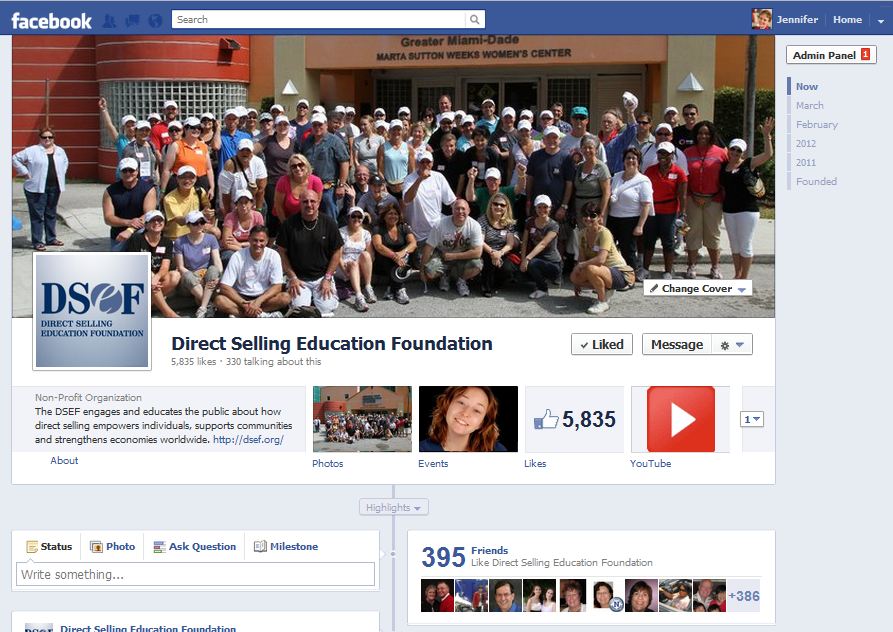
The DSEF's Facebook Timeline
Using the Facebook Page Timeline to Succeed in Business

The DSEF's Facebook TimelineAs of March 30, 2012, all Facebook Pages will automatically be switched over to the new Timeline format. Like any change, there are of course some new features to get used to. But by using your Page strategically, you can benefit your business which can help you build success. Here are some strategies you may want to consider:

  • What do you want your cover image to say about your business? 
    Much has been written around the blog-o-sphere about selecting a cover image. Whatever image you choose to use, make sure that the image tells the story you intend. If your business is primarily about cooking, perhaps you want to show people enjoying delicious food or having fun in the kitchen (this says you’re about making cooking delicious and fun). If your business is personal coaching, perhaps you want to include an inspirational saying along with photos of groups of people who seem connected (this says you’re about building people up emotionally and connecting them). If your Page is more about team building, perhaps you want to include enthusiastic pictures of your team (this says your team is a fun and active place to be.) The important thing is to think about what you want to express as a brand, and then choose or create a cover image that reflects that message.Here’s a useful article that provides some examples of Facebook cover photos (some by direct sellers): http://www.wchingya.com/2012/03/facebook-page-cover-photo.html
  • Keep the conversation alive. As an entrepreneur, one of your biggest advantages on your Facebook Page is the opportunity to connect with people personally, and engage in conversation. So be sure you’re continually checking out the comments that others make on your page, and responding in a timely manner.
  • Post engaging content. Just like with the old Page layout, the majority of interaction with your Page will occur within the News Feed (Facebook home page) and NOT on the Page itself. So be sure you’re using the type of content that engages. Here’s an article with 7 essential steps for writing updates on your Page that engage: http://www.jenfongspeaks.com/7-essential-steps-for-writing-engaging-facebook-page-updates/
  • Track your stats. The best way to improve something is to track it. And Facebook makes it easy to do just that with Insights for Pages. Click on “See All” next to the Insights snapshot on your new Admin panel, and take a look at the stats on each of your posts. This will give you a really good idea of the kinds of posts that resonate best with your Page community.  (Do more of them!) Review the parts of the world where people talking about your Page come from. And so on. By understanding who is using your Page, and how, you can replicated the actions that are bringing you the most results.
  • Highlight your apps. Maybe you’ve got a tab set up on your Page where people can sign up for your newsletter, or a custom welcome tab. Even though you can’t set these up as default landing tabs anymore, you can still highlight them. Arrange them underneath your cover image (you can change the order), and choose custom photos for each. Here is a set of free custom Facebook app icons you may want to use: http://www.jonloomer.com/2012/03/19/facebook-timeline-for-pages-free-facebook-app-icons/

Change can often be a challenge, but like it or not the new Timeline is here to stay (for now!) Best to embrace the challenge and find ways to make the new format work for you.

What would you add? How are you using the new Timeline for Pages to build your business? Would love to read your thoughts in the comments below!

Free e-book “Business Owner’s Road Map to Success.” It has over 50 pages of techniques for everything a small business owner needs to master, from business planning and ethical selling to a success mindset. It’s all there and it’s free for you. To get it, just “Like” our Facebook Page here: http://on.fb.me/KsIN6P Pass it on!