

By Suzanne Altobello, PhD, Caroline Glackin, PhD, and William G. Collier, PhD
Introduction
Direct selling depends on independent representatives who choose to stay, advocate for the opportunity, and help grow the salesforce. Because representatives are not traditional employees, direct selling organizations (DSOs) often win or lose on perceived fit and meaning between the representative and the company, rather than formal supervision. We examined whether identity-related perceptions, such as commitment, shared values, identification, brand meaning and long-term orientation, help to explain three practical outcomes of income, willingness to recommend the DSO/direct selling to others, and likelihood of continuing as a representative.
This research explores how independent sales representatives integrate into the brand and company, and how to strengthen these relationships. Previous studies in the sales literature have examined salesperson/brand identification with the organization and the congruence between personal values and perceived values of the organization, but have not addressed these factors for contract salespeople. This survey was designed for replication and extension of Gammoh et al. (2014) and engaged direct sellers from two organizations.
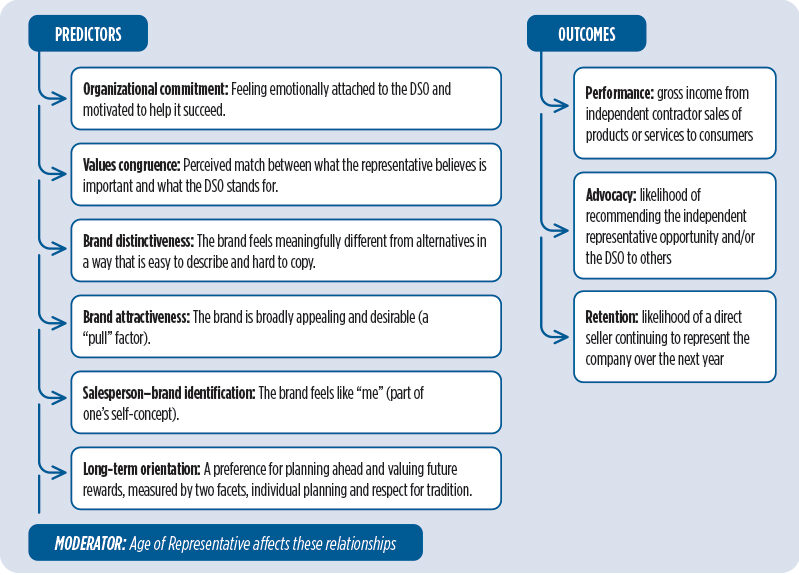
We modeled three outcomes that matter to DSOs: gross income from sales of products or services by their independent salesforce to consumers (performance), a direct seller’s likelihood of recommending the opportunity to one’s network (advocacy), and a direct seller’s likelihood of continuing to represent the company over the next year (retention). We tested whether these outcomes were predicted by Social Identity Theory constructs including: organizational commitment, salesperson–DSO values congruence, brand distinctiveness, brand attractiveness, salesperson–brand identification, along with long-term orientation (individual planning; respect for tradition). Figure 1 provides brief definitions of our predictors and outcomes.
Figure 1
Predictors and Outcomes in Research Models
Theory and Hypotheses
Social Identity Theory
In practical terms, Social Identity Theory (SIT) helps explain why people work harder and stay longer when they feel they truly belong to a group or organization. Originating in social psychology, SIT argues that individuals define part of who they are through their membership in social groups, such as a company, a brand community, or a sales team (Fiske and Taylor, 1991; Tajfel, 1978; Tajfel and Turner, 1986; Ashforth and Mael, 2024). People tend to see their own group (the ingroup) more positively than other groups (outgroups) (Tajfel et al., 1971). When they believe their group has distinctive and attractive qualities, that pride in membership can boost self esteem and strengthen their desire to stay connected to the group (Fiske and Taylor, 1991). In sales and service settings, this logic underpins related ideas such as organizational identity (Karanika-Murray et al., 2015), moral identity (Itani and Chaker, 2022), perceived inclusion (Chen and Tang, 2018), salesperson brand identification, and salesperson company identification (Gammoh et al., 2014). All of these constructs capture how strongly people feel that “this organization or brand is part of who I am.”
For practitioners, the implication is straightforward: when representatives feel that “this company stands for what I stand for” and “this brand fits who I am,” they are more likely to stay, to advocate for the organization, and to deliver better performance.
Gammoh et al. (2014) and van Dick (2001) describe social identity as having cognitive, evaluative, emotional, and behavioral components. Cognitively, individuals see themselves as part of the group. Evaluatively and emotionally, they feel pride and positive regard for that membership. Behaviorally, they support the ingroup through actions that help and benefit it, such as going the extra mile for customers or defending the brand when it is criticized.
Gammoh et al. (2014) applied SIT to company employed salespeople and showed how these ideas translate into day-to-day performance. They found that when salespeople perceived strong value congruence (e.g., when their personal values matched the values of the brand and the company), they reported higher identification with both. This stronger sense of identity was linked to greater job satisfaction and organizational commitment. In turn, these attitudes were associated with more effective behavioral and outcome performance, including clearer communication and stronger sales results. For practitioners, the implication is straightforward: when representatives feel that “this company stands for what I stand for” and “this brand fits who I am,” they are more likely to stay, to advocate for the organization, and to deliver better performance.
Long-Term Orientation
Long-term orientation in selling captures whether a salesperson is focused on near-term transactions or on the future consequences of today’s behaviors for customer relationships and business outcomes. In sales settings, research suggests that a stronger consideration of future sales consequences, paired with customer-oriented selling, helps explain a salesperson’s long-term relationship orientation and related preferences such as favoring longer-term compensation approaches (Schultz & Good, 2000). Work on salespeople’s “relational time perspective” similarly argues that representatives with longer time horizons tend to set goals differently and rely more on cooperative, problem-solving approaches that support relationship development over time (Macintosh, 2006). More recent sales research also connects salesperson time orientation to outcomes such as sustained effort during a new product launch and customers’ willingness to pay more, highlighting that future-focused selling can matter for both salesperson behavior and customer responses (Agnihotri et al., 2019; Beuk et al., 2014).
Age as a moderator
For direct selling organizations, age is more than a demographic label; it can shape how representatives think about their role, how they relate to the company, and how they behave toward others. DSOs routinely attract people at very different stages of life, from young adults looking for a side income to older adults seeking flexible work in semi-retirement. Although research on how Social Identity Theory operates by age is still limited, several studies suggest meaningful age differences in the behavior component. Matsumoto et al. (2016) find that older individuals tend to engage in more prosocial behaviors, while Lockwood et al. (2021) report that adults aged 55 to 84 are more willing to help others than adults aged 18 to 36. Cutler et al. (2021) show that older adults are especially likely to direct prosocial behaviors toward people they see as members of their own group. In sales contexts, Day (1993) also finds that older salespeople set higher annual sales goals and achieve them just as well as younger colleagues. For DSOs, recognizing these age-related patterns can support more precise recruitment messages and motivational strategies that align with representatives’ life stage and long-term orientation, rather than using a single approach for all age groups.
Method
A quantitative survey was sent via email to independent representatives of two established member companies of the Direct Selling Association. Both companies were similar in product characteristics but differed in overall revenues. All participant responses were anonymous and went directly to the research team. Companies did not have access to any raw, individual-level data.
Measures
The dependent variables in the analysis are each respondent’s gross income from direct selling in the previous year, the likelihood of recommending becoming an independent sales representative to a friend or family member, and the likelihood of continuing to represent the company over the next year. The independent predictor variables included: salesperson/company identification, salesperson/company values congruence, salesperson/brand identification, brand distinctiveness, brand attractiveness, organizational commitment, and long-term orientation. All SIT predictors were measured using established scales from Gammoh et al. (2014). Long-term orientation was measured using the Bearden et al. (2006) scale, which operationalizes long-term orientation at the individual level as two related factors: planning and tradition.
Sample profile
A total of 592 representatives started the survey; 295 respondents had complete data across all predictor and outcome measures. The ages of all current independent sales representatives ranged from 18 to 74, with a mean of 45.81 (SD = 11.24) years, with no significant differences in age between the companies.
Most respondents were between 40 and 50 years old (39.5%) and female (88.3%).
Almost 70% are married, with approximately equal percentages of single (8.2%) and divorced/separated (9.5%) respondents. Most representatives had no children under 18 at home (40.8%), with equal percentages having one (17.4%) or two children (20.8%). Most respondents were not of Hispanic or Latino origin (84.8%) and had attained an associate’s degree or some college (29.9%) or were college graduates (30.6%).
Results
We first estimated separate stepwise regression models for each of the three outcomes.
We used all respondents in these initial analyses and did not separate by age group.
For sales performance (as measured by the respondent’s reported gross income from direct selling), organizational commitment was the only predictor that showed a statistically significant relationship. Representatives who reported higher organizational commitment also tended to report higher gross income from direct selling. None of the other predictors added meaningful explanatory power once commitment was taken into account.
For the advocacy outcome (as measured by the likelihood of recommending the DSO), organizational commitment and salesperson/company values congruence were the only significant predictors. Representatives who felt more committed to the organization and who perceived a stronger match between their personal values and the DSO’s values reported a higher likelihood of recommending the opportunity to others.
For the retention outcome (as measured by the likelihood of continuing as a representative over the next year), salesperson/company values congruence and brand distinctiveness emerged as significant predictors. Representatives who saw a stronger match between their own values and the values of the DSO, and who viewed the brand as meaningfully different from alternatives, were more likely to say that they intended to continue representing the company.
Table 1
Significant Predictors of Direct Selling Outcomes for all Representatives
| Outcome | Model Fit | Significant Predictors | β | t | Sig. |
| Performance | R2 = .018, F (1, 282) = 5.114, p < .025 | Organizational Commitment |
.133 | 2.261 | .024 |
| Advocacy | R2 = .344, F (2, 281) = 73.69, p < .001 | Organizational Commitment |
.405 | 6.597 | <.001 |
| Salesperson/DSO Values Congruence | .242 | 3.935 | <.001 | ||
| Retention | R2 = .325, F (2, 281) = 40.858, p < .001 | Salesperson/DSO Values Congruence | .378 | 6.195 | <.001 |
| Brand Distinctiveness | .153 | 2.500 | .013 | ||
Age as a Moderator
We then examined whether the patterns just described varied by age group.
Respondents were grouped into three categories: under 40, 40 to 50, and 51 and older, and the regression models were re-estimated within each group. For performance, no variables remained significant once the sample was split by age, so age related differences in income are not interpreted further.
For the likelihood of recommending the DSO, the predictors differed by age group.
Among representatives under 40, those who saw the brand as attractive and who felt strongly committed to the organization were more likely to say they would recommend the opportunity. For representatives aged 40 to 50, recommendation was highest when three elements coincided: they felt that their personal values matched the DSO’s values, they viewed the brand as attractive, and they reported strong organizational commitment. Among representatives 51 and older, a different pattern emerged. In this group, advocacy was higher when they perceived a strong values be match with the DSO, saw the brand as clearly distinctive from others in the market, and the sales rep had a stronger long-term, tradition-oriented outlook. At the same time, those over 50 who perceived the brand as highly attractive were actually less likely to recommend it.
Table 2
Positive and Negative Patterns of Predictors for Advocacy Outcome by Age Groups
| Predictor | Under 40 | 40–50 | 51+ |
| Organizational commitment | + | + | |
| Salesperson–DSO values congruence | + | + | |
| Brand attractiveness | + | + | – |
| Brand distinctiveness | + | ||
| Long-term orientation: respect for tradition | + | ||
| Long-term orientation: individual planning | |||
| Salesperson–brand identification |
For the likelihood of continuing with the DSO, a similar pattern of age specific drivers emerged, as shown in Table 3. Among representatives under 40, salesperson or DSO value congruence and brand attractiveness were significant positive predictors of continuation intentions. In the 40 to 50 group, brand attractiveness and the long-term orientation dimension capturing individual planning were significant and positive. Retention again looked different for the oldest group of representatives (51+). For older representatives, a strong values match and a clear sense that the brand is unique went together with stronger continuation intentions.
However, in this same age group, those who said that the brand felt very much like “me” and those who saw the brand as very attractive were less likely to say they planned to continue.
Table 3
Positive and Negative Patterns of Predictors for Retention Outcome by Age Groups
| Predictor | Under 40 | 40–50 | 51+ |
| Salesperson–DSO values congruence | + | + | |
| Brand attractiveness | + | + | – |
| Brand distinctiveness | + | ||
| Salesperson–brand identification | – | ||
| Long-term orientation: individual planning | + | ||
| Long-term orientation: respect for tradition | |||
| Organizational commitment |
Discussion
For performance, organizational commitment was the only consistent driver in the full sample. When the sample was split into age groups, the income patterns were less stable and did not yield clear age-specific drivers. For independent sales representatives in this dataset, sales performance is tied most closely to whether representatives felt a durable bond with the organization.
For the advocacy outcome, across the full sample, recommending the DSO was higher if representatives were committed to the organization and their sense that the DSO’s values matched their own. When we examined advocacy by age groups, organizational commitment mattered for younger and midlife representatives, and values congruence mattered strongly for older representatives (notably, though, brand attractiveness moved in the opposite direction for this group).
For the retention outcome, for all representatives, the strongest pattern for continuing with the DSO was a values match with the DSO plus a belief that the brand is meaningfully distinctive. When separated by age, values congruence remained important for the youngest and oldest groups, while brand attractiveness mattered for the younger and midlife groups. The older representatives in this sample appeared less likely to continue when the brand felt highly attractive or when the representative reported that the brand felt very much like “me.”
Practical Implications and Conclusions
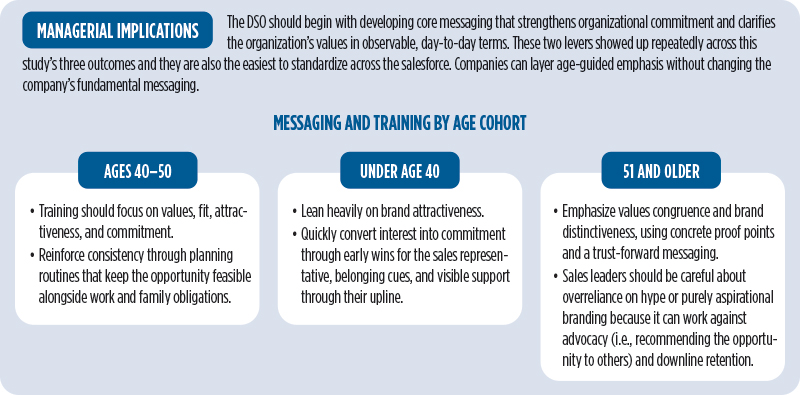
Our results can be applied to existing independent sales representatives and extend to recruitment and onboarding new representatives. The DSO should begin with a shared core that strengthens organizational commitment and clarifies the organization’s values in observable, day-to-day terms; these two levers showed up repeatedly across this study’s three outcomes, and they are also the easiest to standardize across the salesforce.
Age-based Recommendations for Company Training and Onboarding
In Figure 2, we illustrate how the DSO can layer age-guided emphasis without changing the company’s fundamentals. Under 40 messaging and training could lean more heavily on brand attractiveness while quickly converting interest into commitment through early wins for the sales representative, belonging cues, and visible support through their upline. For ages 40–50, training might intentionally combine values fit, attractiveness, and commitment, then reinforce consistency through planning routines that keep the opportunity feasible alongside work and family obligations. For 51 and older, the emphasis could shift toward values congruence and brand distinctiveness, using concrete proof points and a trust-forward message; in this group, leaders should be careful about overreliance on hype or purely aspirational branding because it can work against advocacy and retention.
Proposed DSO Toolkit Architecture

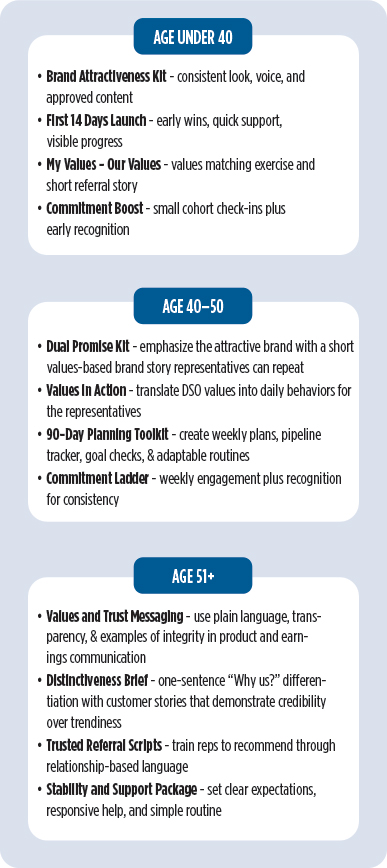
In Figure 3, we propose an overall toolkit architecture that DSO managers and leaders can use in coaching, communications, and recognition. The first toolkit could be a values fit toolkit that includes brief screening prompts during recruiting, a “values in action” onboarding module that shows how values appear in product claims and team norms, and mentor check-ins that surface misalignment early. The second toolkit could be a distinctiveness toolkit that gives representatives a one-sentence “why us” statement, compliant comparisons, and customer stories that make the brand’s difference easy to explain and hard to copy. The third toolkit could be a planning toolkit that provides weekly activity plans, 90-day goals, and pipeline tracking, especially for the 40–50 segment where planning aligned with continuation.
Dr. Suzanne Altobello is the William H. Belk Distinguished Chair of Business Administration and Professor of Marketing at University of North Carolina Pembroke.
Dr. Caroline Glackin is the Thomas Family Distinguished Professor of Entrepreneurship at the University of North Carolina Pembroke.
Dr. William Collier is an Associate Professor of Cognitive Psychology at the University of North Carolina Pembroke.
References
- Agnihotri, R., Yang, Z., & Briggs, E. (2019). Salesperson time perspectives and customer willingness to pay more: Roles of intraorganizational employee navigation, customer satisfaction, and firm innovation climate. Journal of Personal Selling & Sales Management, 39(2), 138–158.
- Ashforth, B.E., & Mael, F.A. (2024). Back to the future: What we’d change in “Social Identity Theory and the Organization” (Academy of Management Review, 1989, 14, 20-39). Journal of Management Inquiry, 33(4), 329-335.
- Bearden, W. O., Money, R. B., & Nevins, J. L. (2006). A measure of long-term orientation: Development and validation. Journal of the Academy of Marketing Science, 34(3), 456-467.
- Beuk, F., Malter, A. J., Spanjol, J., & Cocco, J. (2014). Financial incentives and salesperson time orientation in new product launch: A longitudinal study. Journal of Product Innovation Management, 31(4), 647–663.
- Chen, C., & Tang, N. (2018). Does perceived inclusion matter in the workplace?” Journal of Managerial Psychology 33(1), 43–57.
- Cutler, J., Nitschke, J. P., Lamm, C., & Lockwood, P. L. (2021). Older adults across the globe exhibit increased prosocial behavior but also greater in-group preferences. Nature Aging, 1, 880-888.
- Day, N. E. (1993). Performance in salespeople—the impact of age. Journal of Managerial Issues, 254-273.
- Fiske, S.T., and Taylor, S.E. (1991). Social Cognition. 2nd ed. McGraw-Hill.
- Gammoh, B., Mallin, M., & Pullins, E. (2014). Antecedents and consequences of salesperson identification with the brand and company. Journal of Personal Selling & Sales Management 34(1), 3 – 18.
- Itani, O. S., & Chaker, N. N. (2022). Harnessing the power within: The consequences of salesperson moral identity and the moderating role of internal competitive climate. Journal of Business Ethics, 181, 847-871.
- Karanika-Murray, M., Duncan, N., Pontes, H.M., & Griffiths, M.D. (2015). Organizational identification, work engagement, and job satisfaction. Journal of Managerial Psychology 30(8), 1019–1033.
- Lockwood, P. L., Abdurahman, A., Gabay, A. S., Drew, D., Tamm, M., Husain, M., & Apps, M. A. J. (2021). Aging increases prosocial motivation and effort. Psychological Science, 32(5), 668-681.
- Macintosh, G. (2006). Personality and relational time perspective in selling: A paper based instrument for measuring client relationship longevity. Journal of Selling & Major Account Management, 6(2), 19–33.
- Matsumoto, Y., Yamagishi, T., Li, Y., & Kiyonari, T. (2016). Prosocial behavior increases with age across five economic games. Plos One, 11(7), e0158671.
- Schultz, R. J., & Good, D. J. (2000). Impact of the consideration of future sales consequences and customer-oriented selling on long-term buyer-seller relationships. Journal of Business & Industrial Marketing, 15(4), 200–215.
- Tajfel, H. (1978). Differentiation between social groups: Studies in the social psychology of intergroup relations. Academic Press.
- Tajfel, H., Billig, M. G., Bundy, R. P., & Flament, C. (1971). Social categorization and intergroup behaviour. European Journal of Social Psychology, 1(2), 149-178.
- Tajfel, H., & Turner, J. C. (1986). The social identity theory of intergroup behavior. In S. Worchel and W. G. Austin (Eds.), Psychology of Intergroup Relations. Hall Publishers, 7-24.
- van Dick, R. (2001). Identification in organizational contexts: Linking theory and research from social and organizational psychology. International Journal of Management Reviews, 3(4), 265-283.
